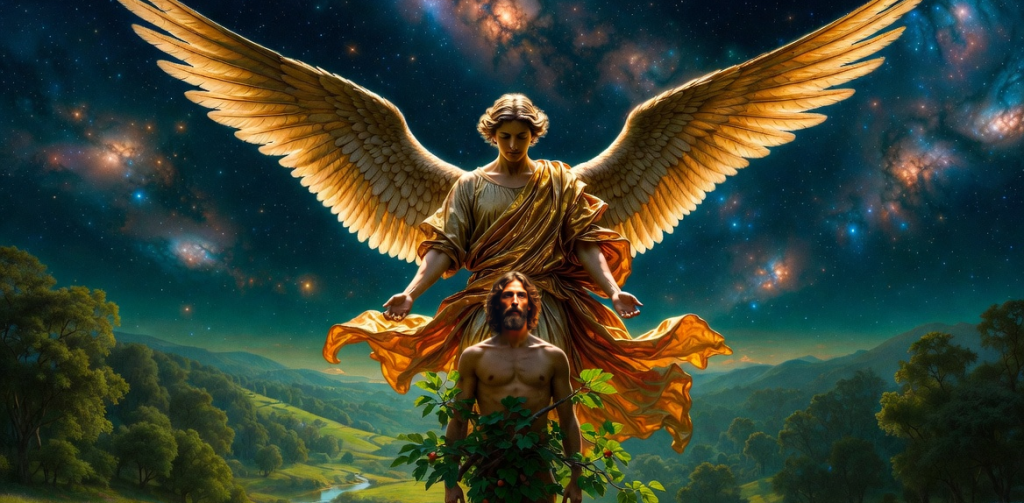
image created using Grok AI.
You can download a PDF of this study: A Little Lower than Elohim? – PDF
You can also download and listen to an Audio of this study: A Little Lower than Elohim? – Spotify Podcast
A brief excerpt of the study: The purpose of this study is to address a simple misinterpretation that is related to the Hebrew word “Elohim,” which is normally translated as God. However, in some instances this word is also used to refer to heavenly beings. So, in some cases we are required to use the context of the passage to determine the intended meaning, and it is one such incident which we will address in this study.
We will begin with a prayer: We thank you, Lord, for this opportunity, our prayer is for your word to go out in the power of your Spirit so that it might bring repentance to the knowledge of the truth to those who hear, we pray this in the name of the Lord Jesus Christ. Amen.
The main text of our study is from Psalm 8 verses 4 to 6, which reads, “What is man that You should remember him, and the son of man, that You would attend to him? And You made him lacking a little from [elohim,] and with glory and honor You crowned him. You made him to rule over the works of Your hands; You have placed everything under his feet.”
The Hebrew word “elohim” in this passage has been translated as either ‘God’ or ‘angels’; in which regard Bible translators are split almost half and half on the matter. Considering how God is set far apart from the angels of heaven, it is very curious that the translators would make such a mistake. Because if we stop for a moment and contemplate the implication of translating this word to mean God in contrast to mankind, then the magnitude of the fallacy of that statement becomes apparent. The question is why did they do that? The answer has to do with the theology of the creation of Mankind in the image of God, and the assumptions we have made in regard to this matter. The most insidious one is that we have presumed the image of God to be unique to mankind. Then the reason for the error in translation becomes, if mankind is the only creation in all of God’s handiwork to bear His image, then, mankind cannot be compared to no other than God Himself, lest of all angels, whom we have erroneously presumed not to bear His image.
The bible does not tell us the thought process of God when He created the angels of heaven as He did when He created mankind, only that they are the works of His hands in all their glory and beauty, and He has made them to be of the same substance of spirit as God Himself is spirit. [Psalm 104 verse 4, John 4 verse 24.] When God created Adam from the dust of the ground and breathed into his nostrils the breath of life, Adam was called the son of God. [Luke 3 verse 38.] Likewise, the first reference of angels in the bible is in the story of Noah, which states, “When the sons of God came into the daughters of mankind, and they bore children to them. Those were the mighty men who were from of old, men of the name.” Genesis 6 verse 4. There are two major points we want to highlight here, the first is that the angels are called sons of God just as Adam. The Second is the implication that is made in regards to the superior might of angels, which was illustrated through the children the daughters of men bore to them, as being distinct from that of common mankind. Likewise, Moses also writes, “Rejoice, O heavens, with Him, and let all God’s angels worship Him. Rejoice, O nations, with His people;” Deuteronomy 32 verse 43. The word that is translated as “God’s angels,” is the Hebrew word “bene elohim,” which is normally translated as “sons of God.” And when Paul quoted this verse in his letter to the Hebrews, he wrote, “And let all angels of God worship Him.” Hebrews 1 verse 6. Through which Paul directly translated, “sons of God” to mean, “angels of God.”
Now, the term “sons of God,” is meant to express ones that exhibit the nature of God being in a relationship with Him. In which regard Job writes, “And there was a day when the sons of God came to present themselves before the LORD, that Satan also came into their midst.” Job 1 verse 6. Satan who is just as much an angel as the sons of God, and is spirit, is not included in that term on the account he corrupted himself. [Ezekiel 28 verse 15, & 17.] Likewise, when Adam fell, he also no longer carried the title of the son of God. In which regard Moses writes, “They have corrupted themselves; because of their blemish they are not His sons, a generation perverse and crooked.” Deuteronomy 32 verse 5. The important point here is that the nature of God is exhibited in perfect purity, which applies both to the heavenly beings as well as natural mankind. To this we can add the children of Israel whom God took out of the world to be His people, and established His covenant with them by addressing the issue of sin. So, while the rest of the world was considered to be alienated from God, the children of Israel were considered His children, and sons of the kingdom on the account of His Covenant. The point is, be it angels or mankind, they were all created to be His sons, and to be in relationship with Him according to the domain they were created. In which regard, Jude describing the moment the sons of God transgressed in Genesis says, “And the angels not having kept their domain, but having abandoned their own dwelling, He has kept in eternal chains under gloomy darkness unto the judgment of the great day.” Jude 1 verse 6.
So, each was made in accordance with the dominion they belonged to, angels according to the magnificence of heaven, the dwelling place of God, and mankind according to the natural world. And it is in this regard that Peter and Jude express the feebleness of mankind in comparison to the heavenly beings saying, “They do not tremble blaspheming glorious ones, whereas angels, being greater in strength and power, do not bring against them a reviling judgement before the Lord.” 2 Peter 2 verses 10 to 11. [Jude 1 verses 8 to 9.] Please bear in mind, both Peter and Jude describe these heavenly beings to be glorious and greater in power and might, yet the error in the translation of the main text assumes mankind to be little lower than God Himself.
And this issue gets a little complicated when we take into consideration the Lord’s statement when He said, “Is it not written in your Law: ‘I said you are gods’? If He called them gods to whom the word of God came—and the Scripture is not able to be broken— do you say of Him whom the Father sanctified and sent into the world, ‘You blaspheme,’ because I said, ‘I am the Son of God’?” John 10 verses 34 to 36. Here, the Lord was quoting from the book of Psalms, the context of which states, “I said, ‘You are gods, [that is elohim], and all of you sons of the Most High.’ Surely like a man you will die, and like one of the princes you will fall.” Psalm 82 verses 6 to 7. The important point here is the qualification which the Lord makes, by saying “to whom the word of God came,” in that He specifically confines His statement to apply only to the nation of Israel. Which is the grounds by which the children of Israel are made the children of the kingdom of God, separated from the nations of the world. In which regard the Lord comparing the children of Israel to the rest of the nations said, “And I say to you that many will come from east and west and will recline with Abraham and Isaac and Jacob in the kingdom of the heavens. But the sons of the kingdom will be cast out into the outer darkness—there will be weeping and gnashing of the teeth.” Matthew 8 verses 11 to 12. So, the term elohim is associated with those that have entered in a relationship with God, as to be known to Him through the Covenant He had made with them, as Paul pointed out in Romans 9 verses 3 to 5, and also in Ephesians 2 verses 11 to 12.
So, in the context of the full view of the statement, we can understand why He would say to them, “like man you will die.” The point God was making was that you were created to be gods as it relates to the quality of possessing eternal life being sons of the Most High God, yet because of sin you will die like man. In which regard Ezekiel also said of the Prince of Tyre, “Will you really say, ‘I am a god, [that is elohim],’ before the face of the One slaying you and you are a man and not a god in the hand of the One slaying you?” Ezekiel 28 verse 9. The term elohim is used in respect to possessing the quality of God, which is to be eternal as He is eternal. So, mankind was created to be elohim in the natural world, as the angels were elohim in the spiritual. In which regard Psalms referring to the angels says, “God takes His stand in the congregation of the divine; among the gods [that is elohim,] He renders judgment.” Psalms 82 verse 1. And again, “For who in the heavens can be compared to the LORD, likened to the LORD among the sons of the mighty?” Psalm 89 verse 6. The sons of the mighty in Hebrew is, “beni elim,” which can also be translated as, “sons of the gods,” which is in reference to the congregation of heavenly beings. [Psalm 29 verse 1.]
The main point is, the comparison is not about might or power, but eternal life, which the Lord Himself affirmed when He compared those that are considered worthy to attain the resurrection from the dead, to the angels of heaven and said, “For neither are they able to die anymore, for they are like angels, and they are sons of God, being sons of the resurrection.” Luke 20 verse 36. The term, “they are like angels,” can also be translated to mean, “they are equal to angels.” And for our study the latter translation is convenient, because it corresponds to the issue of being made a little lower than the angels. But the most important question is in what way are those that are considered worthy to attain the resurrection from the dead, likened or are made equal to angels? We have to bear in mind those that are raised from the dead in Christ, will also take on a spiritual body in His likeness, and will also be seated with Him on His throne, which is described as being far above all principality and power. The magnitude of which is expressed by Paul saying, “He worked in Christ, having raised Him out from the dead, and having seated Him at His right hand in the heavenly realms, far above every principality and authority and power and lordship and every name being named, not only in this age, but also in the one about to be. And He put all things under His feet and gave Him to be head over all things to the Church, which is His body, the fullness of the One filling all in all.” Ephesians 1 verses 20 to 23. And we, having been united as one with Him being His body have become co-inheritors with Him. Therefore, the only element of significance for comparison with angels is as it relates to possessing eternal life. And we also need to bear in mind, even though God is the possessor of eternal life, when the Lord said, “Neither are they able to die anymore,” He does not use God as a comparison point, but He uses other created beings, that is angels. And this is an important point, because the eternal life that is associated with God, has neither a beginning nor an end, so there can be no comparison made with Him.
Therefore, when David said, ‘Thou hast made him a little lower than elohim,’ he was not comparing mankind to God Himself, but to other created beings that hold the same status as sons of God. And this is illustrated in the beginning of his statement, which states, “When I see Your heavens, the works of Your fingers, the moon and the stars that You have established—” Then he asks, “what is man that You should remember him.” And in the context of comparing mankind against the splendour of God’s creation he says, “You made him lacking a little from [elohim].” Now, when saying, “the moon and the stars,” the implication is that of the Heavenly beings, and we find this in the writing of John which states, “Behold, a great fiery red dragon having seven heads and ten horns, and upon his heads seven diadems. And his tail drags a third of the stars of heaven, and he cast them to the earth.” Revelation 12 verses 3 to 4. And John explains the meaning of this vision saying, “And the great dragon was thrown out, the ancient serpent who is called the Devil and Satan, deceiving the whole world. He was thrown to the earth, and his angels were thrown with him.” Revelation 12 verse 9. We can see John attributed the stars of heaven to be a representation of the angels of heaven. So David was comparing Heaven to Earth, and in respect to those that dwell in them. Now in all truth, the question of the misapplication of the Hebrew word “elohim” as it relates to the main text of our study, is perfectly resolved through the teaching of Pastor Joseph Prince, who pointed out that the statement “You made him lacking a little from the elohim,” is translated by none other than the apostle Paul himself saying, “You made him a little lower than the angels.” Hebrews 2 verse 7. In that, he pointed out Paul translated the Hebrew word “elohim,” to the Greek word “angelos,” meaning angels, thereby resolving all ambiguity once and for all.
Having said this, when Paul made the comparison between angels and mankind, the basis of which was on the account of the statement, “For not to angels did He subject the world that is about to be, concerning which we are speaking.” Hebrews 2 verse 5. If the world that is to come is going to be made subject to mankind, in contrast to angels, then we have to ask what is the New World constituted of, and how is this meant to be achieved. Because, angels and mankind do not traditionally occupy the same realm, yet the New world to come, sets one in authority over the other. Meaning, Heaven and Earth are brought together, as John in Revelation 21 verses 1 to 4 pointed out, when the New Jerusalem descended upon the New Earth, saying the dwelling place of God is with mankind. In which regard Paul also says, “For the administration of the fullness of the times, to bring together all things in Christ—the things in the heavens and the things upon the earth—” Ephesians 1 verse 10. So, this New World consists of the realm of God represented in the Bride of Christ, the New Jerusalem, being present among the realm of mankind on the New Earth. Please Note the implication, Heaven, the dwelling place of God is called the Bride of Christ, where prominence is given to the New Creation that is the Church, which is distinct from the angels of heaven whose domain is heaven, and distinct from flesh-mankind whose domain is the earth, and to whom both heaven and earth are made subject in Christ. So, the next question we need to address is, how is mankind that was created flesh and natural, and was lower than the angels, is now raised to administer both heaven and earth?
And this is where the Lord whose nature is Spirit from everlasting takes prominence, when He took the form of mankind, in order to make purification for sins. God has always administered Heaven, but the earth He did give to be under the dominion of mankind, as the Psalmist says, “The heavens of the heavens are unto the LORD, and the earth He has given to the sons of man.” Psalm 115 verse 16. Having said this, the earth was meant to be administered in covenant with God, in which regard Hosea says, “And they, like Adam, transgressed the covenant; there they were unfaithful with Me.” Hosea 6 verse 7. So, as the result of Adam breaking the covenant by which the earth was meant to be administered, the earth fell under the administration of the kingdom of darkness, which ruled the world in sin. And since the dominion of the Earth was given to mankind, it can only be redeemed through mankind, for which reason, the Word God had to take the form of a Man. And Paul describing the eternal plan of God says, “and by Him to reconcile all things to Himself, having made peace by the blood of His cross through Him, whether the things on the earth or the things in the heavens.” Colossians 1 verse 20. So, the Lord came bearing the image of Adam in order to make reconciliation through His death, but He was lifted up as a New Creation, as a Life-Giving Spirit. [1 Corinthians 15 verse 45.] So, the One through whom everything was made, is also the means by which everything is brought under the administration of God, both the things in Heaven and Earth. Meaning, His nature must reconcile both God and Man, in Him. And this is the New Creation by which mankind that was created flesh is raised to the height of heaven’s throne to be inheritors of both heaven and earth in Him, because mankind is made a dwelling place of God. [Ephesians 2 verses 20 to 22.]
With this in mind, Paul in the first chapter of Hebrews labours to establish the deity of the Lord Jesus Christ and says, “In these last days spoke to us in His Son, whom He appointed heir of all things, through whom also He made the ages, who, being the radiance of His glory and the exact imprint of His substance and bearing all things by the word of power—through His having made purification of sins— sat down at the right hand of the Majesty on high, having become so much better than the angels, as much as He has inherited a name more excellent beyond theirs.” Hebrews 1 verses 2 to 4. Throughout this statement Paul is expressing the duality of the nature of the Lord, on one hand he describes the Lord as one through whom the worlds are made, giving Him preeminence over everything that is ever created. And One who is a perfect representation of God and through the might of His power everything is upheld. Then he follows with the nature that is related to mankind, through which He made purification for sins, at which point Paul compares Him to other created beings. Please note, he began comparing Him to God, in order to reflect His perfect resemblance to God being a creator of all things, yet he finishes comparing Him to the angels of God. So, Paul in a manner is portraying from where the Lord descended, in order to illustrate His true Everlasting Deity, and he describes to where He ascended, in order to illustrate the status to which He is elevated among created beings as a Man, and us with Him. In which regard Paul says, “Christ Jesus: Who, existing in the form of God, did not consider to be equal with God something to be grasped, but emptied Himself, having taken the form of a servant, having been made in the likeness of men. And having been found in appearance as a man He humbled Himself, having become obedient unto death, even the death of the cross. Therefore God also highly exalted Him, and granted to Him the name above every name, that at the name of Jesus every knee should bow, in the heavens and on earth and under the earth, and every tongue should confess that Jesus Christ is Lord, to the glory of God the Father.” Philippians 2 verses 5 to 11.
The main point Paul wanted to make is to express how the Eternal God entered into His own creation, for the purpose of reconciliation. For which reason Paul begins by describing the moment the Word God took the form of a created being, and quotes the Psalm of David that says, “You are My Son; today I have begotten You.” The most important point is that, the term “the Son of God” as it relates to the Eternal God the Word, has a beginning. The term “Son of God” was never intended to express the true nature of the deity of the Lord, but rather the fact that the Eternal God had taken the form of a created being, to whom the term “sons of God” is attributed to both angels of God and Adam. [Romans 5 verse 14.] And Paul further establishes this point by quoting the prophecy given to king David as it relates to the Messiah and says, “I will be to Him for a Father, and He will be to Me for a Son.” Hebrews 1 verse 5. Please note how this statement illustrates the moment a relationship that can be characterised as between a Father and a Son is first established. We have to bear in mind, the word “Son,” by its very nature expresses one that comes after, for which reason its application must have a starting point. As such, it is specifically reserved to portray the moment the Everlasting God the Word, took the form of a Man. And this point is illustrated when we read the Psalm of David in context, which says, “You are My Son; today I have begotten You. Ask from Me and I will give the nations as Your inheritance, and the ends of the earth for Your possession.” Psalms 2 verses 7 to 8. By this very statement God was revealing the moment the Word God took the form of a Man, since He could not have inherited the Earth without being one. Remember, God has given the Earth to the sons of man. Meaning, God had to be His Father, as He took the form of the Son of Man, thereby describing the means by which reconciliation is made, through which the Earth is brought under the Man Jesus Christ.
And Paul follows that statement with, “when He brings the Firstborn into the world,” that is to say, Jesus Christ is the firstborn of God, and the Only begotten of the Father. In which regard John writes, “And the Word became flesh and dwelt among us. And we beheld His glory, a glory as of an only begotten from the Father, full of grace and truth.” John 1 verse 14. And again, “No one has ever yet seen God. The only begotten God, the One being in the bosom of the Father, He has made Him known.” John 1 verse 18. The first point to address is that, John is not saying, the Word God was begotten or created, since He has always been from everlasting. [Micah 5 verse 2.] In that, the Word has always been, and is God. God has always existed from the beginning in One form as Spirit, but expressed in three Persons: The Father, The Word and The Holy Spirit. So when he says, “when He brings the Firstborn into the world,” Paul is describing the moment God the Word was begotten, to be born flesh as Jesus Christ the Son of Man. [Hebrews 2 verse 14.]
Adam, was one that was brought forth from the dust of the ground to be flesh, but the Lord Jesus Christ is the Word made flesh. In that the Lord had a form of preexistence, which Paul describes saying, “Christ Jesus, who, existing in the form of God, did not consider to be equal with God something to be grasped, but emptied Himself, having taken the form of a servant, having been made in the likeness of men.” Philippians 2 verses 6 to 7. And the Lord Himself, expressing His coming forth in the same manner as the Holy Spirit says, “When the Helper comes, whom I will send to you from the Father, the Spirit of truth who goes forth from the Father.” John 15 verse 26. Likewise, He says of Himself, “I came forth from the Father and have come into the world; again I leave the world and go to the Father.” John 16 verse 28. Therefore, every Divine Person of the Godhead is of the same substance of Spirit, and have co-existed without a beginning as Father, Word, and Holy Spirit. So, we need to draw a distinction between the Word and the Son, Jesus Christ. Though we speak of the same divine Person there is a moment in time when One took the form and attributes of the Other, whereby the Word became the Son, because He took unto Himself the nature of Man.
And it is this point which Paul wanted to make very clear while comparing the Lord as One that has taken the form of a created being and says, “When He brings the Firstborn into the world, He says: “And let all angels of God worship Him.” Please note, it is obvious that only God is meant to be worshiped, but here instruction is given in respect to the One that took the form of a Man, which is meant to illustrate the fact that He is deserving of worship that is due to God, though He has appeared in the form of a Man. Thereby expressing His dual nature as both God and Man. Which Paul illustrates by showing the distinction of the position the Son is meant to hold in contrast to that of the angels of God and says, “And indeed as to the angels He says: “The One making His angels winds, and His ministers a flame of fire.” But unto the Son: “Your throne, O God, is to the age of the age, and the scepter of righteousness is the scepter of Your kingdom.” Hebrews 1 verses 7 to 8. Please note, it is as unto the Son, meaning, as One who took the form of a created being, otherwise the comparison with the angels does not make sense. But even in this respect, Paul illustrates the angels as ones that are created and made for the purpose of service, to minister to those who inherit salvation, but the Son is described as one who is sat on the throne as God, through whom everything is created, and says, “You, in the beginning, Lord, laid the foundation of the earth, and the heavens are works of Your hands. They will perish but You remain;” Hebrews 1 verses 10 to 11. The point is that His beginning is from everlasting in that even the angels are His creation, nor does He have an end. [Colossians 1 verses 15 to 19.]
So, Paul after establishing this fact, in respect to the Deity of the One that took the form of a Man, he once more compares the Lord against the angels of God, but only this time he does so, in respect to the Lord as a representation of the Son of Man and says, “For not to angels did He subject the world that is about to be, concerning which we are speaking, but someone somewhere solemnly testified, saying, “What is man that You are mindful of him, or the son of man that You care for him? You made him a little less than the angels;” Hebrews 2 verses 5 to 7. Please note, in saying the world to come is not made subject to angels, he by default made it subject to mankind. And Paul elaborating on this says, “For in subjecting all things to him, He left nothing unsubject to him. But at present not yet do we see all things having been subjected to him. But we see Jesus, who was made a little lower than the angels, because of the suffering of death, having been crowned with glory and with honor, so that by the grace of God He might taste death for everyone.” Hebrews 2 verses 8 to 9.
So when David says, “you made him a little lower than the angels,” Paul applied it to the Lord Jesus Christ, and confined the basis of comparison to the aspect of possessing eternal life. This is because the perspective is according to each in his own domain, mankind is not compared against the domain of heaven, nor angels according to the domain of earth. Nevertheless, each in the appointed domain was meant to be possessors of eternal life, so in this regard he says, a little lower than the angels for the suffering of death. So, we are not a little lower than God because we die, even angels who do not die are described to be so far below the throne of God. So the comparison between Jesus and the angels is on the basis of the type in the likeness of Adam, for which reason the Lord is referred to as the Last Adam, the Word God made flesh. [Romans 5 verse 14, 1 Corinthians 15 verse 45.] In this regard, Paul who laboured much to illustrate the Deity of the Lord in contrast to the angels of God in the first chapter, now makes a comparison as relates to His humility in taking the form of a Man. In that, the Word God did not become like angels to help angels, but became like the Son of Man to help Mankind. [Hebrews 2 verses 16 to 17.]
The most important point of this study is to form in our thoughts, that mankind is the most humblest among all of God’s creations that bear His image. And this is what we keep missing, when we compare and elevate ourselves against the angels of God. When God made Adam, He did not bestow upon him great might, as He did with the glorious angels of heaven, but He made him from the dust of the ground to be stark naked, and bestowed upon him the dominion of the earth, which was meant to be realised in relationship with God only. In contrast Ezekiel describes the creation of the angel Lucifer and says, “You were the seal of perfection, full of wisdom and perfect in beauty! You were in Eden, the garden of God, with every precious stone your covering ruby, topaz, and diamond; beryl, onyx, and jasper; sapphire, turquoise, and emerald; and of gold was the workmanship of your timbrels and pipes, established for you on the day of your creation.” Ezekiel 28 verses 12 to 13. Please note the vast contrast between the creation of mankind and that of an angel. And we need to consider which is greater, to be on earth far from the presence of God, or to stand before Him as spirit and look at the face of the Father? A point which Gabriel also made when he spoke to Zechariah saying, “I am Gabriel, the one standing before God; and I was sent to speak to you, and to bring these glad tidings to you.” Luke 1 verse 19. So, at creation mankind was made lower than the angels, meaning Mankind in the flesh did not hold higher prominence than angels who stood before God.
God did not make us the way we are, so that He may rejoice in the strength of our might, but rather in our absolute lack and the nakedness of our being, we may be utterly dependent on Him, and through Him we may possess everything. So it is humility that is meant to be observed in mankind, which is a far more endearing quality to God, that is why God resists the proud but delights in the humble. And Paul rejoiced in his weakness saying, “And He has said to me, “My grace suffices for you, for the power is perfected in weakness.” Most gladly, therefore, rather, I will boast in my weaknesses, so that the power of Christ may rest upon me.” 2 Corinthians 12 verses 9 to 10. So, the humbleness of our being is not something to shrink back from, but something we are to gladly recognise and embrace. God is all might and power and glory, as such, He does not take pleasure in the strength of man, and dare say that of angels since all are the works of His hands, but His delight is in those who trust in Him. Therefore, it is in knowing the humbleness of our being that we possess strength.
This is what David found hard to grasp, when he considered the feebleness of mankind against the splendour of heaven. And the wonder in all heaven and earth is that these beings that once were made of dust, and whose lifespan was just as fleeting in the wind, are now lifted up so far above that of all of God’s creation that are in heaven and earth, and are seated on the throne of Heaven with Christ. [Ephesians 2 verse 6.] And this is the very message of the gospel of Christ. Christ from the heights of the glory of Heaven humbled Himself to come down to take the form of a Man and was obedient unto death, so that when He was raised to His glory, He lifted us up with Him, not according to the strength of our might, but according to the power of God. In that, the reason mankind is lifted up from the lowly humble state to the throne of God in Christ, is because we have been made the dwelling place of the Spirit of God, whom we have through the Lord Jesus Christ. As Paul said, “But you are not in the flesh but in the Spirit, if indeed the Spirit of God dwells in you; and if anyone does not have the Spirit of Christ, this one is not of Him. But if Christ is in you, the body is indeed dead because of sin, but the spirit is life because of righteousness.” Romans 8 verses 9 to 10. [1 Corinthians 6 verse 17.]
So, the Might of All Mightes, meets the humblest of God’s creation in Christ, through which the grace and wonders of God are magnified. That is why the Lord said, “Truly, truly, I say to you, the Son is able to do nothing from Himself, if not anything He may see the Father doing; for whatever He may do, these things the Son also does likewise.” And again, “I am able to do nothing from Myself.” John 5 verses 19, & 30. Likewise, He says to us, “I am the vine; you are the branches. The one abiding in Me and I in him, he bears much fruit. For apart from Me you are able to do nothing.” John 15 verse 15. That is why, the Holy Spirit makes His dwelling in those who know their weakness and have need of a Saviour, being in Christ which is the New Creation. So, Christ is the means and the illustration by which God and Mankind can be presented united as one. [John 17 verses 21 to 23.]
In which respect, the New World to come is one where Heaven and Earth are brought under one in Christ. The nature of angels is not changed, whose domain is heaven, nor that of flesh-mankind whose dwelling will be the New Earth. But for those that are in Christ, as the Lord said, “those having been considered worthy to obtain that which is to the age, and the resurrection which is from the dead,” that is to be Spirit-Mankind as He is the Heavenly Man, to them both heaven and earth has become their inheritance. [Romans 8 verse 17.] So, the New Jerusalem, the dwelling place of God is called the Bride of Christ, that is to say the Church. [Revelation 3 verse 12.] And through whom the purposes of God are now meant to be administered to all of creation. As Paul says, “To enlighten all what is the administration of the mystery having been hidden from the ages in God, the One having created all things, so that now through the Church the manifold wisdom of God should be made known to the rulers and authorities in the heavenly realms, according to the purpose of the ages, which He accomplished in Christ Jesus our Lord.” Ephesians 3 verses 9 to 11.
We conclude our study with the wisdom of the late great teacher Derek Prince who taught saying, Lucifer who was great in might and beauty lifted himself up to grasp at the Throne of God, and was brought down to be the dust of the ground. While Christ, who is God, humbled Himself to become Man, and was obedient even to die the death of the cross. So God lifted Him up to the highest of the heavens and gave Him a name above all names. In which respect Paul tells us, we ought to have the mind like that of Christ. So, it is in Christ we who were created from the dust of the ground are lifted up to be clothed with all the splendour of heaven. And the fact that Lucifer is brought down from the glory of heaven to our state should reveal to us the humbleness of our beginning.
 Bread Bait.
Leave a comment