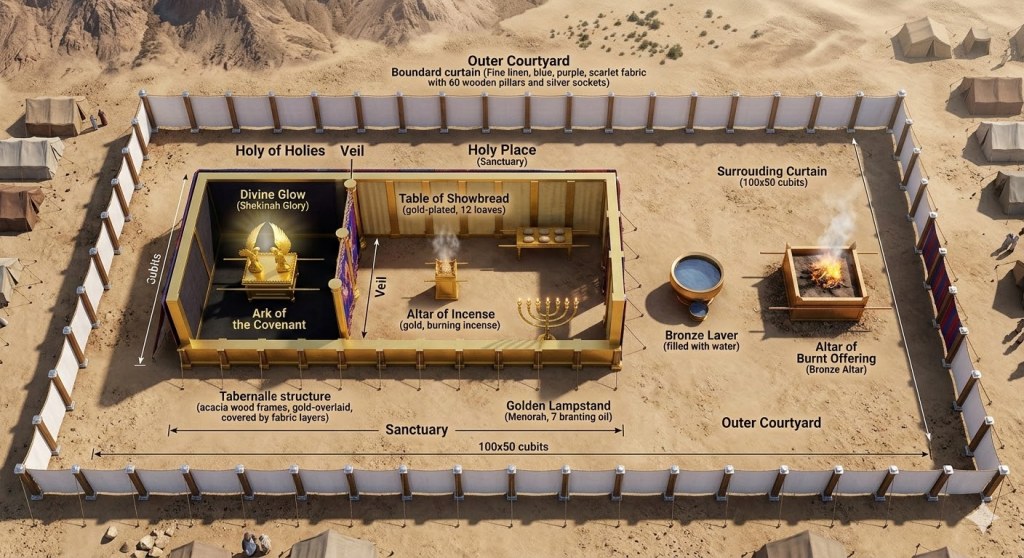
Created using google Gemini nano banana 2 AI image generator.
You can download a PDF of this study: Veil of Separation – PDF
You can also download and listen to an Audio of this study: Veil of Separation – Spotify Podcast
Content.
- Introduction.
- The Tabernacle of Moses.
- The Reconciliation.
- The Tabernacle of David.
- The Division of Soul and Spirit.
A brief excerpt of the study: The aim of this study is to establish the fact mankind was not created spirit, and only in Christ we have the opportunity to become one. And we hope to do this with a visual depiction of the Temple of God being superimposed over the makeup of Mankind as Spirit, Soul and Body. The main point being, the Tabernacle design given to Moses in the wilderness gives insight into the fall of Adam. Likewise, through the teaching of Paul, our new nature as spirit can also be expressed through the depiction of the Temple of God, in respect to the Cross of Christ as it relates to the Tabernacle of David.
We will begin with a prayer: We thank you, Lord, for this opportunity, our prayer is for your word to go out in the power of your Spirit so that it might bring repentance to the knowledge of the truth to those who hear, we pray this in the name of the Lord Jesus Christ. Amen.
The main text of our study is from Hebrews 9 verses 6 to 9, “Now these things having been prepared thus, indeed the priests enter into the first tabernacle regularly, accomplishing the sacred services. But only the high priest enters into the second, once in the year, not without blood, which he offers for himself and the sins of ignorance of the people. By this the Holy Spirit was signifying that the way into the holy places has not yet been made manifest, the first tabernacle still having a standing, which is a symbol for the present time, in which both gifts and sacrifices are offered, not being able to make perfect in regard to conscience the one worshiping.”
Introduction.
The first important point we need to establish is the direct link that is portrayed between the Tabernacle of Moses and that of our body. Paul said, “Do you not know that your body is a temple of the Holy Spirit in you, whom you have from God?” 1 Corinthians 6 verse 19. By saying our body is the Temple of God, Paul literally superimposed the layout of the Temple of Moses to that of the makeup of mankind. The Tabernacle of God is described in three main components, the Holy of Holies where the Ark of the covenant is located, followed by the Sanctuary separated from the Holy of Holies by a Veil, where we find the table of the presence, the golden lampstand, and the altar of incense. Finally, beyond the screen door of the tabernacle of meeting, we have the Outer Court, where we find the Bronze Laver and the Altar of Sacrifice. Likewise, the makeup of mankind is also represented in three parts, the Spirit, that corresponds to the Holy of Holies, the Soul to the Sanctuary, and the Body which relates to the Outer Court.
In the main text of our study, Paul made a reference to the fact that the priests entered into the sanctuary regularly to perform the duties that are required. However, into the Holy of Holies, only the Chief Priest entered and that once in a year, and not without blood, to make offerings for his own sins and the sins of the people that were committed in ignorance. The main point we are trying to make here is that, the separating Veil that is between the Holy of Holies and the Sanctuary, is a representation of a condemned conscience that came into effect on the account of the sin of Adam. So the thousands upon thousands of offerings of the blood of bulls and calves could never take away the guilty conscience of the one who offered the gift. That is to say, between the Soul of Mankind and the Spirit of Mankind there was a veil of separation, which was a product of a condemned conscience, which came to effect on the account of our Soul being made subject to the body of Sin. As Paul says, “Because of this, just as sin entered into the world through one man, and death through sin, so also death passed to all men, because all sinned.” Romans 5 verse 12. The main purpose of which was to portray to us the permanent state of separation that came to effect between God and Mankind, as long as sin is a factor.
And, in contrast to the Law that could not remove the veil of separation that existed between God and Mankind, Paul describing the sacrifice of the Lord Jesus Christ says, “But Christ, having appeared as high priest of the good things having come, by the greater and more perfect tabernacle not made by hands, that is, not of this creation, nor by blood of goats and calves, but through the own blood, He entered once for all into the holy places, having obtained eternal redemption.” After which Paul describes the effect of the outcome of this sacrifice and says, “How much more will the blood of Christ, who through the eternal Spirit offered Himself unblemished to God, purify our conscience from dead works, in order to serve the living God!” Hebrews 9 verse 11 to 12, & 14. That is to say, Christ once and for all, entered into the Holy Places through His own blood having put away sin, as a result everyone who approaches God by the blood of Jesus Christ is able to do so with a Clean Conscience, being justified from all things which he was not able to be justified through the Law of Moses. [Acts 13 verse 39.] The point of significance between the Sacrifices that were offered in the Law, to that of the Lord, was the conscience of the one that offered the blood of the Lord Jesus Christ is perfectly purified from the consciousness of sin. [Hebrews 10 verses 1 to 2.] The effect of which was that the Holy Spirit bearing witness, that the way to the Holy of Holies is now made open by the blood of Jesus Christ, in a portrayal of a restored relationship with God.
Now, before we go any further, if we are to understand the true nature of mankind, we need to establish where the conscience of mankind is located. Many times we have heard the definition of the Soul to be consisting of, the mind, the will, and emotions, as such we are told the Soul is something we possess not something we are. But this is a great error, the root cause of which is that it wrongfully assumes mankind was created spirit. As a result such an approach attributes conscience to be an aspect of the spirit of mankind, and not that of the Soul. However, Paul said, “How much more will the blood of Christ, who through the eternal Spirit offered Himself unblemished to God, purify our conscience from dead works, in order to serve the living God!” Hebrews 9 verse 14. And Peter, expressing the same sentiment as Paul, first says, “Knowing that you were redeemed from your futile manner of life … by the precious blood of Christ.” Then he says, “Having purified your souls in obedience to the truth … having been born again, not of perishable seed, but of imperishable, by the living and abiding word of God.” 1 Peter 1 verses 18 to 19, & 22 to 23. In that, Peter associates being born again to the moment the Soul is purified by the blood of Christ through obedience to the truth of God. And by comparing the statements of Paul and Peter, we can conclude the blood of the Lord Jesus Christ purifies our Conscience, which is the same as saying, our Soul. And this truth is further established according to the Law of Moses that states, “For the life of the flesh is in the blood, and I have given it to you upon the altar to make atonement for your souls; for it is the blood that makes atonement for the soul.” Leviticus 17 verse 11. So, the fact that our conscience is purified by the blood of the Lord Jesus Christ means, conscience is not an aspect of the spirit of mankind, but that of the soul. Then we may say, the true nature in the expression of the unique essence of a person is found in the Soul, and that is why when God breathed the breath of life into the form of clay, Paul quoting Genesis said, “The first man Adam became into a living soul.” 1 Corinthians 15 verse 45.
So, many times when the bible makes a comparison between the outer-man and the inner-man, it is making a comparison between the Body and the Soul. Which Paul sought to reveal to us through the conflict that exists between the Soul and the body of sin, in respect to the giving of the Law. For which reason he says, “For we know that the Law is spiritual; but I am fleshly, having been sold under sin.” Romans 7 verse 14. And he describes the state of slavery which he finds himself in, saying, “For I delight in the Law of God according to the inward man; but I see another law in my members, warring against the law of my mind, and making me captive to the law of sin being in my members.” Romans 7 verses 22 to 23. Paul is describing the torment of a mind that seeks to do what is right according to the Law of God, but finding no power to do so, he succumbs to the dictate of the law of sin that ruled in his body. We need to bear in mind, Paul is describing here the struggle of a person who has not yet known Christ, as one who is still a slave to the body of sin. For which reason he says, “O wretched man I am! Who will deliver me out of this body of death? Thanks be then to God, through Jesus Christ our Lord!” Romans 7 verses 24 to 25. So it is in this context, Paul clearly states the inward man to be the possessor of the mind that knows the Law of God, that is to say the soul, which he then contrasts against the outward man that was subject to the law of sin, meaning his body. Likewise in 2 Corinthians 4 verse 16, he contrasts the outward man that is growing old, to the inward man that is being renewed day by day. That is to say, our soul as it pertains to the spirit of our mind is being renewed through the knowledge of the Son of God, while our body is growing old. [Romans 12 verse 2, Ephesians 4 verse 23, Colossians 3 verse 10.]
Now, we have established the basic foundation for our study. We will explore the implication of what the veil being removed signifies as it relates to the New Nature in Christ. And, in order to better understand our new nature as being in the spirit that comes through Christ, it is important for us to know how Adam became a slave to the body of sin, which is the corresponding expression for being in the flesh.
The Tabernacle of Moses.
The first thing we need to bear in mind is that the design of the Tabernacle of Moses, is meant to be a reflection of the state of fallen mankind, expressed through the Law of God. That is to say, the separations that are identified as the Veil of Separation between the Holy of Holies and the Sanctuary, the Tabernacle door that stands between the Sanctuary and the Courtyard, as well as the gates of the Courtyard, are all given as an illustration of the contrary nature that came to effect through Adam’s one act of disobedience. [Exodus 40 verses 21, 28, & 33.] We have to understand the primary purpose of the Law was to reveal the nature of sin that dwelt in Mankind, that is why Paul said, “for through the Law is knowledge of sin.” Romans 3 verse 20. As such, the tabernacle of Moses is not an expression of perfection, but a temporary installment that was necessary for instruction until the perfect should come. [Galatians 3 verse 19.]
The Fall of the Body.
The commonly accepted narrative dictates that the central part of mankind should be the spirit, but if we look at the Tabernacle of Moses closely, we will see the central object in the expression of mankind is not the spirit, but the Soul, with the spirit to one side, and the body to the other. This is because, when God created mankind he did not create a spirit being, but a Living Soul, as Paul referencing Adam’s original creation said, “The first man Adam became into a living soul.” That is to say, at the point of creation there were no points of separation between Adam’s soul, spirit, and body, since Adam had a perfect conscience, and lived in a body that was free from the dominion of sin. The effect of which was that Adam was created to be a Living Soul, neither subject to his spirit, nor to his body. We have to remember, the only way Adam could possibly be considered to be in the spirit, is if in fact the Spirit of God was dwelling in him, as Paul says, “you are not in flesh but in spirit, if indeed the Spirit of God dwells in you.” And we know Adam did not have the Spirit of God, since the Spirit of God was never given until Christ was glorified. [John 7 verses 38 to 39.] Nor was Adam subject to his body in order to be in the flesh, since there was no sin in the world. [Romans 5 verse 12.] And this is the main point which we miss, being subject to sin or righteousness is a direct result of being under the spirit of the world, or that of the Spirit of God. Having said this, at creation Adam had no conflict within him, his spirit, soul, and body, were all united to be one, as such he reflected the image of the perfect unity of God.
We are made in the image of God, meaning as God is, Father, Son, and Holy Spirit, yet one God, we were also created spirit, soul and body, yet one person. And it is this aspect of multiplicity represented in perfect unity, which God revealed about Himself in the very first sentence of the bible, saying, “In the beginning God created the heavens and the earth.” Genesis 1 verse 1. In that when saying, “God,” the plural Hebrew word, “Elohim,” is used. Likewise, John also writes, “In the beginning was the Word, and the Word was with God, and the Word was God.” John 1 verse 1. However, we make a mistake when we think we are made in the image of God as spirits, because God is spirit, when the image God wanted us to reflect of Him was that of a perfect unity, regardless of the material of our makeup. [John 17 verses 21 to 23.] That is why God said, “Let Us make man in Our image, according to Our likeness.” Genesis 1 verse 26. Note how God repeatedly refers to Himself in the plural to that of the singular of man, meaning, it is the plurality of the image of God which is meant to be reflected in the singular man. And it is this image of perfect unity of God that was marred in mankind the moment separation entered into our being through sin.
That is to say, when Eve being deceived by the serpent, took of the fruit of the tree of the knowledge of Good and Evil and ate, and gave some for Adam also to eat, then Genesis states, “Then the eyes of both of them were opened, and they knew that they were naked; and they sewed fig leaves together and made themselves coverings.” The outcome of which was that, “Adam and his wife hid themselves from the presence of the LORD God among the trees of the garden.” Genesis 3 verses 7 to 8. The first step of this process was that the serpent made Eve doubt the authority of her husband, when he asked her, “Has God indeed said, “You shall not eat of every tree of the garden?” Genesis 3 verse 1. We have to bear in mind, Eve was not privy when the commandment of God was given, so she only had the word of her husband Adam. So in effect by that question, the serpent put a wedge between her and Adam. Now she was faced with the choice of believing the word of God presented to her, through the godly authority of her husband, or that of the twisted deceit of the serpent with the intent of usurping that very authority. And when she ate of the tree, it was like she brought herself under the authority of the serpent that deceived her, to the relegation of her husband’s. And when Adam in return heeded the voice of Eve, himself not being deceived, he in effect abdicated his authority and became a slave to his body ruled by the spirit of the world. Through which, his understanding was now opened to the knowledge of evil, and his conscience was condemned. As such through the failure of Adam, sin entered the world and through sin death. Now the important point for us to see is that, since Eve who represents the body is the one that ate first, it is the Body that died not the spirit, for which reason Paul makes the point, “The body is indeed dead on account of sin.” Romans 8 verse 10. And a condemned conscience as an aspect of the Soul, which Adam represents, comes as a consequence of submitting to the body of sin.
And, the first outcome of the knowledge of evil was that Adam and Eve became estranged from each other, that is the Head from the Body. The two that once stood naked before one another being united as one, now saw difference and separation, so in shame, they covered themselves from one another. That is to say, the first instance of separation described in the bible had to do between the Soul and Body of Mankind, which Paul worked hard to explain in Romans 7 verses 21 to 24. So Eve being the body was deceived by the desires of the serpent, and Adam as the Head, that is to say the Soul, acted accordingly to the desires of his wife against the explicit word of God, and this became the expression for sin. So, he who was created to be a Living Soul, became a slave to his body that was ruled by sin, the result of which was that Adam became the first person to be in the flesh. Hence the reason the spirit of bondage is defined as the Soul being subservient to the body ruled by the spirit of the world. [Romans 7 verse 14.] As a result, in fear and condemnation they hid themselves from the presence of God, which is the second expression of separation. [Romans 8 verse 15.]
The consequence of this new state of being in the flesh was that the devil having become the god of this world was given authority over the body of natural mankind, that is why it is called the body of sin. And Paul describing our state in the flesh says, “Once you walked according to the age of this world, according to the ruler of the authority of the air, the spirit now working in the sons of disobedience, among whom we all also once lived in the desires of our flesh, doing the things willed of the flesh and of its thoughts.” Ephesians 2 verses 2 to 3. So, just as sin entered the world, sin also entered our body through which it had mastery over us. Which Paul described saying, “While we were in the flesh, the passions of sins that were through the Law were at work in our members, to the bringing forth of fruit to death.” Romans 7 verse 5. Paul is making the point that the Soul of mankind that is bound to the body of sin is subject to its whims and desires, the end of which is to bring forth death. Because the body of sin has a mind of its own, which was according to the spirit of the world. As Paul says, “For the mind of the flesh is death; but the mind of the Spirit, life and peace, because the mind of the flesh is hostility toward God; for it is not subject to the Law of God, for not even can it be.” Romans 8 verses 6 to 7. And Paul describes the outcome of this state that came through Adam as, “through one trespass, it is unto condemnation to all men.” And again, “through the disobedience of the one man, the many were made sinners.” Romans 5 verses 18, & 19.
Now, it is worth for us to note, it is in regard to the the body exercising authority over the head, in playing a role for which it was not designed that Paul was referring when he said, “I do not permit a woman to teach, nor to use authority over a man, but to be in quietness. For Adam was formed first, then Eve. And Adam was not deceived, but the woman, having been deceived, has come into transgression.” 1 Timothy 2 verses 12 to 14. Here, Paul is describing the relationship between a Husband and a Wife, and is not in any way speaking about the hierarchy of the Church. [1 Corinthians 12 verses 27 to 28.] That is why Paul makes the point that Adam was formed first, then Eve, through which he established Adam’s authority as the Head, and Eve as the Body. Meaning, it is all about the role we are created to play as husband and wife. And if in Christ we are a new Creation, and are expected not to regard anyone according to the flesh, why would Paul point us to Adam and Eve? That is because, the only thing that they represent as far as it concerns us in the earth, is in regards to the Covenant of Marriage, where the headship of man over woman is applicable, since they are considered to be one flesh. [1 Corinthians 11 verse 2 to 16.] However, in the Church, Christ is the Head, the firstborn from the dead, while we are all His body, without any distinction between Jew or Gentile, male or female. [Colossians 1 verse 18.] And the fact that Adam was not deceived when he ate, means it was not because Eve convinced him through her new found wisdom that he acted in disobedience. The simple fact of which was that Adam valued the created being more than the Creator, and he abdicated his authority. [Romans 1 verse 25.] And we need to bear in mind, the church is full of examples of men being deceived through false teaching, so being born a man does not necessarily give anyone extra wisdom in the Church. We must be created anew as spirits, and as spirits, it is the gift and calling of God that matters, not our sex. As Paul says, “Our sufficiency is of God, who also has made us competent as ministers of a new covenant, not of the letter, but of the Spirit.” 2 Corinthians 3 verses 5 to 6.
And this separation between Soul and Body is expressed in the Tabernacle of Moses, through the Screen door of the Tabernacle of Meeting. Which is woven of blue, purple, and scarlet thread, and fine woven linen, and is set on 5 pillars of acacia wood covered with gold, standing on sockets made of bronze. [Exodus 26 verses 36 to 37.] The Screen door stands before the Sanctuary where we find, the golden lampstand, the table of the presence where fresh bread is placed, and the incense altar. And it is a representation of the Word of God given to mankind by the inspiration of the Holy Spirit, through which we make our prayers to God. So in effect it represents a mind that is set apart from the world through the knowledge of God’s Word. Therefore, the Screen door represents the barrier that came to effect between the Soul that knows the Law of God, and the body of sin, represented in the courtyard where sacrifices for sins are continually made. And it is the disagreement that came to effect between the two through the Law, which Paul tried to explain in Romans chapter 7. Now the fact that the pillars are set in sockets of bronze is meant to represent judgment of death that came to effect. [Romans 5 verse 13.]
And since the Law is given to govern the fallen flesh of mankind, its teaching, explanation and enforcements of its precepts were strictly given through men. Which is in respect to Adam who had the direct command of God, and Eve, who was deceived by the desires of the serpent. This is illustrated in the fact only men are allowed to enter into the Sanctuary. And the priests that minister within it are given a strict command to wear linen shorts, “And you shall make for them linen trousers to cover their nakedness; they shall reach from the waist to the thighs. They shall be on Aaron and on his sons when they come into the tabernacle of meeting, or when they come near the altar to minister in the holy place, that they do not incur iniquity and die.” Exodus 28 verses 42 to 43. The linen trousers are a covering for the knowledge of nakedness that came to effect, when Adam gave into the desires of his wife that was deceived and abdicated his authority, as a result was drawn away from God. So, the screen door of the tabernacle meeting represents the separation between Soul and body, and between man and woman through the linen shorts, in respect to the covering of the body of sin that came to effect at the fall. [Genesis 3 verses 7, 10 & 12.] The point is the barriers are established in recognition of conflict, which is even expressed in divorce that was granted for any reason through the Law of Moses. [Matthew 19 verse 3.]
The Fall of Conscience.
Thus far we have discussed the separation that came to effect between Soul and Body, illustrated through the estrangement of Adam from Eve, through the influence of the serpent. We will now address the obscuring of the mind of the Soul, which is illustrated through the Veil Moses used to cover his face. The point being, there is a direct correlation between the Veil Moses used to cover his face from the children of Israel, and the Veil that separated the Holy of Holies from the Sanctuary. In that, it represents understanding of spiritual truths in respect to direct relationship with the Author. Paul wrote, “The ministry of death, having been engraved in letters on stones, was produced in glory, so as for the sons of Israel not to be able to look intently into the face of Moses, on account of the glory of his face which is fading.” Then he says, “But their minds were hardened; for until the present day, the same veil remains at the reading of the old covenant, not being lifted, which is being removed in Christ. But unto this day, when Moses shall be read, a veil lies over their heart. But whenever one shall have turned to the Lord, the veil is taken away.” 2 Corinthians 3 verses 7, & 14 to 15.
The Law of Moses is called a ministry of death and condemnation, in that, it was never meant to be a means for justification. [Galatians 2 verse 16.] So, the Law being a ministry of condemnation, does nothing to cleanse the conscience of the one who trespassed. As Paul said, “By works of the Law, not any flesh will be justified before Him; for through the Law is knowledge of sin.” Romans 3 verse 20. And again, “For the Law, having a shadow of the good things coming, not the form of the things themselves, never is able each year, with the same sacrifices which they offer continually, to perfect those drawing near.” Hebrews 10 verse 1. And Pastor Joseph Prince pointed out that it was in respect to a condemned conscience that the children of Israel feared to approach Moses, when his face was shining through the glory of the Law, because it was revealing their sins.
When considering this we might ask, how was it that Moses who established the Law was exempt from its blinding effect, while the congregations of Israel were not? The answer is, Moses was never under the Covenant of the Law. Paul writes, “[The Law] was added on account of transgressions, until the seed to whom promise has been made should have come, having been ordained through angels in the hand of a mediator.” Galatians 3 verse 20. [Acts 7 verse 38.] So, Moses as a mediator was not under the Law which he established for Israel. And Paul describing the moment the Law was established said, “For of every commandment having been spoken by Moses to all the people according to the Law, having taken the blood of calves and of goats, with water and scarlet wool and hyssop, he sprinkled both the book itself and all the people, saying, “This is the blood of the covenant, which God commanded unto you.” And likewise he sprinkled also the tabernacle and all the vessels of the ministry with blood.” Hebrews 9 verses 19 to 21. Please note how Moses consecrated the Book, the priests, the people, and the Tabernacle with the blood of sacrifice, yet he himself was not sprinkled with blood of the Covenant of the Law. So, as Mediator of the Law, he stood apart from the Law in the Grace of God, for which reason God says to him, “For you have found grace in My sight, and I know you by name.” Exodus 33 verse 17. And this is reflected in the veil that he put on his face when he spoke to Israel, but removed when he came in the presence of God to talk to Him face to face. [Exodus 34 verse 34.]
It is through a condemned conscience we have a wrong perspective of God, that is to say, it is on the account of sin that our understanding of God is obscured. We need to remember, it is the knowledge of evil that Adam and Eve acquired when they ate from the tree of good and evil, on the account of which, they sought to hide themselves from the presence of God in fear. And the Lord describing the serpent that deceived them said, “He was a murderer from the beginning, and has not stood in the truth, because there is no truth in him. Whenever he might speak falsehood, he speaks from [his] own; for he is a liar, and the father of it.” John 8 verse 44. Meaning, when the world fell under the dominion of the evil one, it is the expression of his nature that entered the world, and by extension our body. The consequence of which is that, even though, “the Law is holy, and the commandment is holy and righteous and good, and is spiritual.” Romans 7 verses 12 &14. However, the one under the Law is in the flesh being under the dominion of sin, as such he is not able to perceive its intended truths, being forever in a state of condemnation. In that, the spirit of the world taking opportunity by the Law, condemns the conscience of the one under it, therefore he is unable to approach God. Consider, through one transgression in the knowledge of his nakedness Adam hid from the presence of God among the trees of the garden. Now, multiply that by the complexities of the law, all of which are designed to reveal some aspect of the nakedness of our flesh nature, the effect of which is a person that is forever seeking to hide from the presence of God. And since the Law of Moses does not justify the conscience of the one who makes the offering for sin, the effect is a blinded person unable to see spiritual truth. [Romans 7 verse 11.] The point being, having a cause to be kept at a distance from the presence of God is an expression for a darkened mind, no matter how enlightened it might appear in contrast to those that are far away, and in utter darkness.
The Word of God is spiritual, the implication of which is that if we are to receive its truth, we ourselves have to first become spiritual. The process by which mankind became flesh, and the means by which he becomes spirit is summarised by Paul saying, “Now we have not received the spirit of the world, but the Spirit from God, that we may know the things having been granted to us by God,” Then he says, “But the natural man does not accept the things of the Spirit of God; for they are foolishness to him, and he is not able to understand them, because spiritually they are discerned. But he who is spiritual judges all things, but he himself is judged by no one.” 1 Corinthians 2 verse 12, & 14 to15. The first thing Paul points out in respect to the natural man that came into being through Adam was that, such a one is under the dominion of the spirit of the world, that is why he says, “we have not received the spirit of the world.” The consequence of which is that, the natural man through the consciousness of evil is not able to understand the truths of God, as Paul says, “the god of this age has blinded the minds of the unbelieving.” 2 Corinthians 4 verse 4. However, in direct contrast to this, Paul says, the spiritual man is one who has received the Spirit that is from God, the result of which is that, he is now able to perceive the truths of God.
Now, even though Israel was drawn near to God through the Covenant of the Law, in an expression of holy flesh. Yet, the condition of being in the flesh that afflicted the Gentiles on the account of sin, afflicted them likewise, for which reason He says, their heart is uncircumcised like that of any man. [Jeremiah 9 verses 25 to 26, Hebrews 9 verse 13.] That is to say, even though they had the knowledge of the Law of God, they did not have the power to perform them. Because all the ritual performances of the Law did nothing to address the root issue of mankind, which is sin. Meaning, blindness when it comes to the spiritual truth of God, universally applies to both Jews and Gentiles, for which reason Paul says, “Forasmuch as both Jews ask for signs, and Greeks seek wisdom, we, however, preach Christ having been crucified, a stumbling block indeed to the Jewish and foolishness to Gentiles.” 1 Corinthians 1 verses 22 to 23.
Here, Paul clearly associates the veil of blindness that is upon the hearts of both Jews and Gentiles, in respect to the means by which sin is removed, that is the Cross. So, the veil of Moses that is on the heart of Israel is not any different from that of a natural man, because it is an expression by which the truth of God that is revealed through a restored relationship with Him is hidden from our sight. Meaning, as long as there is a separation of a condemned conscience, spiritual truth is not given. Which the Lord Himself pointed out saying, “And in them is fulfilled the prophecy of Isaiah, saying: ‘In hearing you will hear and never understand; and in seeing you will see and never perceive. For the heart of this people has grown dull, and they barely hear with the ears, and they have closed their eyes, lest ever they should see with the eyes, and they should hear with the ears, and they should understand with the heart, and should turn, and I will heal them.’” Matthew 13 verses 14 to 15. Please note, the main difference between the disciples of the Lord, and the rest of Israel who were under the Law was that, the disciples of the Lord were granted to understand the mysteries of Heaven on the account that they have believed He is the Messiah, the Son of God. [John 6 verses 68 to 69.]
So, even though many times, they were just as perplexed as the rest of the people who did not understand His parables. However, because the Lord was with them, He explained all things to them in private. [Mark 4 verse 34.] As the Lord said quoting the prophet Isaiah, “And they will all be taught of God.” John 6 verse 45. Here, it is important for us to note the similarities between Moses and the disciples of the Lord, in that, even though they were all in the flesh, the mysteries of heaven were revealed to them on the account they talked with God face to face. [John 14 verse 7.] But to the rest the truth of God was given in parables, as through a veil. And it is this Veil that is illustrated in the Tabernacle of Moses, woven of blue, purple, and scarlet thread, and fine woven linen, with an artistic design of cherubim. Hanging on four pillars of acacia wood overlaid with gold, set in sockets of silver. [Exodus 26 verses 31 to 32.] Separating the Holy of Holies where the presence of God was manifested above the Mercy seat of the Ark of the Covenant, from the Sanctuary. The implication being, for us to be taught by God, in the revelation of the depth of His spiritual truth, we must be able to boldly pass beyond the Veil through the blood of the Lord Jesus Christ, in full assurance of a conscience that is cleansed from sin. [Hebrews 10 verses 19 to 20.] Please note, understanding of truth is always given on the basis of drawing near to God, which was illustrated in Moses, and in the disciples of the Lord, and now it is also illustrated to the Church, where God Himself is revealed as the Teacher. [Ephesians 3 verse 10 to 12.] And the fact the pillars are set in a socket of silver are meant to reveal, our approach to God is defined in terms of redemption and purification. [Hosea 3 verses 1 to 2, Psalm 12 verse 6.]
Now, before closing this section we have to make note of the fence that went around the courtyard. The Screen Gate of which is made of woven linen, hanging on four pillars of bronze set on sockets of bronze. This gate is meant to symbolise the separation between Jew and Gentile, through a people that are set apart to God. The primary expression of which was the covenant of circumcision given to Abraham. [Genesis 17 verses 9 to 11.] As such, no uncircumcised Gentile could possibly enter its perimeters, through which it became an expression for the enmity that existed between the two. [Ephesians 2 verses 11 to 16.] So we can see at every separation point, the tabernacle of Moses defined some element of conflict, which came as a direct consequence of sin. And the fact the socket of the pillars are set in bronze the same as the screen door of the tabernacle of meeting, is for us to realise, it is the Body and Soul of mankind that is subject to the judgment of death, and never the spirit. That is why the concept of spiritual death is very wrong.
So through the knowledge of Evil, the wall of separation came to effect between the Soul and Body. And through an evil conscience, that is to say a condemned conscience, a veil of separation came to effect between the breath of Life and the Soul. As a result, mankind that was once created to be three in one, became estranged from himself. Therefore we can say, death that came through sin is an expression of separation, the fulfilment of which is that the spirit returns to God, the soul to Hades, and the body to the grave. [Psalm 16 verses 8 to 9, & Ecclesiastes 12 verse 7.] And it is this separation which came to effect through sin that the Tabernacle of Moses reveals, through the ministry of Death and Condemnation. And as long as the Tabernacle of Moses stands, that is to say the Law, the separation must remain. As Paul says, “By this the Holy Spirit was signifying that the way into the holy places has not yet been made manifest, the first tabernacle still having a standing,” Hebrews 9 verse 8.
The Reconciliation.
The moment the standing of the Tabernacle of Moses became null and void, was recorded by Matthew saying, “And Jesus, having cried again in a loud voice, yielded up His spirit. And behold, the veil of the temple was torn into two from top to bottom.” Matthew 27 verses 50 to 51. This was meant to be an expression for the revoking of the Veil of separation that came between God and Mankind, on the account the sin of Adam was put away once and for all, through the sacrifice of the Lord Jesus Christ. Through which the previous Covenant of the Law that stipulated separation was made obsolete, in order to establish a new one in Christ in an expression of reconciliation. [2 Corinthians 5 verse 19.] Which Paul describes saying, “He is the mediator of a new covenant, so that, death having taken place for redemption of the transgressions under the first covenant, those having been called might receive the promise of the eternal inheritance.” Hebrews 9 verse 15.
Please note, the desire of God was not so mankind may draw near to Him with some element of distance specified, as He said to Moses in respect to the Law, “Go down and warn the people, lest they break through to gaze at the LORD, and many of them perish.” Exodus 19 verse 24. This condition was given on the account of sin that dwelt in our body. However, in contrast to this stipulation Paul writes, “For indeed, there is a putting away of the preceding commandment, because of its weakness and uselessness (for the Law perfected nothing), and the introduction of a better hope, by which we draw near to God.” Hebrews 7 verses 18 to 19. So, it is no longer “do not let the people come near,” but declare to them the word of reconciliation in the expression of the open arms of God, that invites all to His very presence. And this was made possible on the account of the promise He made through Jeremiah, which Paul used to make his point saying, “And the Holy Spirit also bears witness to us; for after having said before: “This is the covenant that I will make with them, after those days, says the Lord, putting My Laws into their hearts, and I will inscribe them into their mind,”and, “Their sins and their lawless acts, I will remember no more.” Now where there is forgiveness of these, no longer is there an offering for sin.” Hebrews 10 verses 15 to 18. So while the Law of Moses specified layers of separation, the New Covenant of Grace that came through the Lord Jesus Christ was established by removing them.
And Paul describing the process by which we draw near to God said, “Therefore brothers, having confidence for entering the holy places by the blood of Jesus, by a new and living way, which He dedicated for us through the veil that is His flesh, and having a great priest over the house of God, we should draw near with a sincere heart, in full assurance of faith, our hearts having been sprinkled clean from an evil conscience and our body having been washed with pure water.” Hebrews 10 verses 19 to 22. It is very important for us to note, Paul describes the process of drawing near to God to be inclusive of both Soul and Body. In that, the Soul that drew away from the presence of God through a condemned conscience is restored by the Blood, and the Body that was at enmity with God being under the authority of the serpent, is brought to rest in the burial of water. Through which every act of separation specified in the Law of Moses in respect to, Jew and Gentile, man and woman, body and soul, soul and spirit, were all brought to full restoration of unity by one Spirit in righteousness.
The Conscience Purified.
The first point of consideration is the implication of the tearing of the Veil of Separation in relation to the Cross of Christ. That is to say, when the Veil that separated the Holy of Holies from the Sanctuary was torn, these two separate compartments literally became one. And the implication to mankind who believes in the Lord Jesus Christ for justification from sin, is that such a one is now considered to be in the Spirit, as to be born anew. That is to say, when one accepts Christ having been Crucified for the forgiveness of our sins, the veil of separation that was between the soul and spirit through a condemned conscience is removed. Meaning, a Soul that is purified by the Blood of Jesus Christ, being bound to the breath of life in righteousness through the Holy Spirit, is the definition for the New Creation. [Ephesians 1 verse 13.] We deliberately used the words “breath of life,” in order to draw our attention to the fact the Human Spirit is the breath of life we received from God, through which our body is given life, as James says, “For just as the body apart from spirit is dead.” James 2 verse 26. [Psalm 146 verse 4.] The implication of which is that, Creation, the Fall, and Restoration, are all in relation to the Triune nature of mankind, as Soul, Flesh, and Spirit, respectively.
And Peter, describing the moment the Holy of Holies where the presence of God was manifested above the Mercy Seat became one compartment with the Sanctuary that represents the Soul, said, “And the heart-knowing God bore witness to them, having given them the Holy Spirit, as also to us. And He made no distinction between both us and them, having purified their hearts by the faith.” Acts 15 verses 8 to 9. Please Note, the heart being purified by the Blood of Jesus Christ, that is to say, the conscience being cleansed from dead works is the grounds on which the Holy Spirit makes His dwelling in us. And Paul describes the outcome of this new state saying, “Now you are not in flesh but in spirit, if indeed the Spirit of God dwells in you; but if anyone does not have the Spirit of Christ, he is not of Him. But if Christ is in you, the body is indeed dead on account of sin, but the spirit is life on account of righteousness.” Romans 8 verses 9 to 10. Using the framework of the temple of God, Paul is saying, now the veil of separation has been removed by the blood of Jesus Christ, in the portrayal of a purified conscience, the Holy Spirit has now come to seal our soul to our spirit, through whom we are now considered to be in the spirit, and no longer in the flesh. We have to bear in mind, the Holy Spirit that comes to dwell in us is called the Spirit of Christ, on the account that He comes through Him. [John 20 verse 22.] The outcome of which is that we have become a new creation, one that has never existed before, created according to righteousness and holiness of truth, which is in respect to Christ. [2 Corinthians 5 verse 17, Ephesians 4 verse 24.] Please consider the simplicity of the process, we have no need to recreate the human spirit, we only need to identify the change of root of our soul, that was once bound to the flesh in sin through Adam, is now bound to the spirit in righteousness through the Lord Jesus Christ.
And Paul describing the outcome of this unity said, “But thanks be to God that you who were slaves of sin have now become obedient from the heart to the pattern of teaching to which you were committed. And having been set free from sin, you have become slaves to righteousness.” Romans 6 verse 17 to 18. Now, if we can perceive what made us slaves to sin, and why Paul chose to use the words “slaves to righteousness,” we would have a very good understanding of the true nature of mankind in respect to the salvation of God. The point being, you cannot be slaves to sin, unless you are submitted to a master, nor can you be a slave to righteousness unless you do likewise. That is why Paul says, “Do you not know that to whom you yield yourselves as slaves for obedience, you are slaves to him whom you obey, whether of sin to death, or of obedience to righteousness?” Romans 6 verse 16. Sin and righteousness are natures of Satan and of God respectively. That is why righteousness can never be given apart from the Holy Spirit, which is the definition for being in the Spirit.
And the implication of this new state of being in the spirit is marked with one essential feature, that is a heart that is opened to understand spiritual truths. When the Lord was raised from the dead, one of the first things He did was to give His disciples the Holy Spirit, and this was followed by opening their understanding so that they may comprehend the Scriptures. [Luke 24 verse 45, John 20 verse 22.] That is to say, it is precisely in regard to revealing the truth of God, that the Holy Spirit has now come to fulfil in greater measure, in respect to those that are made spirits in Christ. As the Lord said, “But the Helper, the Holy Spirit, whom the Father will send in My name, He will teach you all things and will bring to your remembrance all things that I have said to you.” John 14 verse 26. And again, “Yet I have many things to say to you, but you are not able to bear them now. But when He the, Spirit of truth, shall come, He will guide you into all the truth.” John 16 verses 12 to 13. The point is, the deeper truth of God is revealed to those that are made spirits, as He Himself is Spirit. In which regard Paul says, “For God has revealed it to us through the Spirit. For the Spirit searches all things, even the depths of God.” 1 Corinthians 2 verse 10. So, the Lord who had to restrain Himself from revealing certain truths to His disciples because they were in the flesh, is now given in greater measure because they have been created anew as spirit, through a conscience that is cleansed.
This opening of the eye to perceive spiritual truths is what Paul used in relation to the Veil of Moses, saying, “whenever one shall have turned to the Lord, the veil is taken away.” Paul was making a parallel in respect to the eyes of Adam and Eve, that were opened to the knowledge of Evil as it relates to their flesh, resulting in the condemnation of conscience, thereby blindness to the things of God. [2 Corinthians 4 verses 3 to 4.] Eyes are synonyms for understanding. The Lord said, “The eye is the lamp of the body. So if your eye is clear, your body will be full of light. But if your eye is evil, your whole body will be full of darkness.” Matthew 6 verses 22 to 23. And it is also in the same manner that our eyes are now opened to the things of God, that works in our spirit in righteousness. So, when the Lord sent Paul out to ministry He said, “[I am sending you to the Gentiles,] To open their eyes, that they may turn from darkness to light, and from the power of Satan to God, that they may receive forgiveness of sins and an inheritance among those having been sanctified by faith in Me.” Acts 26 verses 18. Please note, their eyes being opened to the things of the Spirit, which is according to the nature of God, was on the account of their conscience having been purified in the forgiveness of sins. And in each case, be it our fall or redemption, our eyes are described as being opened, because it goes to our understanding of what it means to be in the Flesh or in the Spirit, which is in relation to the nature of a third party.
So, to have an unveiled face is to have the Holy Spirit as a teacher, so that we may grow in the likeness of the image of Him we are created after. For which reason Paul says, “Now the Lord is the Spirit; and where the Spirit of the Lord is, there is freedom. And we all having been unveiled in face, beholding as in a mirror the glory of the Lord, are being transformed into the same image, from glory to glory, even as from the Lord, the Spirit.” 2 Corinthians 3 verses 17 to 18. Meaning, the glory of the Lord is revealed to the one having been made a New Creation in Christ, so that we may grow in His likeness through the knowledge of Him. And Paul understood the vital role the Holy Spirit plays in this regard, so he continually made prayers in respect to the Spirit of wisdom, understanding, knowledge, and strength, which are attributes of the Holy Spirit as specified by Isaiah saying, “The Spirit of the LORD shall rest upon Him, The Spirit of wisdom and understanding, The Spirit of counsel and might, The Spirit of knowledge and of the fear of the LORD.” Isaiah 11 verse 2. That is to say, the Holy Spirit has come to reveal to us the riches of the inheritance of Christ, so we having knowledge, might walk in them by faith to His glory. [Ephesians 1 verses 17 to 19, 1 Corinthians 2 verse 12, Colossians 1 verses 9 to 10.]
The main point of which is that our Soul is considered to be reborn into a new state of being, that is of the righteousness of God in the spirit, through a conscience that is cleansed from sin. And this requires the spirit of our mind to be renewed so that we may live in a manner that expresses His nature. [Titus 2 verses 11 to14.] So, we are expected to grow in the knowledge of the likeness of Him after whom we are created. As Paul says, “You are to have put off, concerning the former way of life, the old man, which is being corrupted according to its desires of deceit, and to be renewed in the spirit of your mind, and to have put on the new man, having been created according to God in righteousness and holiness of truth.” Ephesians 4 verses 22 to 24. [Colossians 3 verses 9 to10.] Likewise, Peter also builds on the fact that our Soul having been purified through belief in the truth, being born of the incorruptible Seed of the Word of God. Then, the very next statement he makes is that, “Like newborn babies, crave pure reasonable milk, so that by it you may grow up in respect to salvation, if indeed you have tasted that the Lord is good.” 1 Peter 2 verses 2 to 3.
Now, the fact we are required to grow in respect to salvation is a significant point. That is, righteousness is not just the forgiveness of sins, but the practice of the nature of God through the knowledge of Him. [1 John 2 verse 29.] The result of which is that we are expected to hold our body in honour by the Holy Spirit. As Paul says, “The One having raised up Christ Jesus out from the dead also will give life to your mortal bodies, on account of His Spirit dwelling in you.” And then he says, “By the Spirit you put to death the deeds of the body and live!” Romans 8 verses 11, & 13. So, in contrast to our body that once gained the mind of the spirit of the world, to become a body of sin to produce death in us. Now, our spirit also gains the mind of Christ through the Holy Spirit in righteousness, which Paul refers to saying, “the mind of the Spirit, [is] life and peace.” That is to say, the Head of our spirit is the Lord, as Paul says, “the one being joined to the Lord is one spirit.” 1 Corinthians 6 verse 17. As a result His desires are now working through us in the knowledge of God, so that His life may be manifested in our mortal bodies, that is our body may be full of light. [2 Corinthians 4 verse 11.]
At this point it is worth for us to note, the growth of a Christian according to righteousness is directly linked to a conscience that is cleansed from sin. So, we may say a condemned conscience is destructive to the growth of a Christian, because the Spirit of God cannot bear witness to a lie. In which respect Peter says, “For these things being in you and abounding, make you neither idle nor unfruitful as to the knowledge of our Lord Jesus Christ. For in whomever these things are not present, he is blind, being short sighted, having received forgetfulness of the purification from his former sins.” 2 Peter 1 verses 8 to 9. Please note how Peter associates blindness to be an aspect of forgetting the heart is purified from sins. Therefore, a teaching that seeks to bring a believer under the condemnation of sin is working contrary to the purpose of God. In contrast, we are required to grow in grace and in the knowledge of the Son of God. [2 Peter 3 verse 18.] The main point of which is that, as we walk by the Spirit of God in grace and righteousness of truth, this ought to have a detrimental effect on the lusts of the flesh, meaning, the deeds of the body are put to death by the Spirit of God. [Romans 8 verse 13, Galatians 5 verse 16.]
The Body Washed.
The second point of consideration in respect to the separation that was specified in the Tabernacle of Moses is in regard to the Body of Sin. What we have to remember is, it is the Body of Adam and Eve that was made subject to death through Sin. The implication of which is that the enemy of our soul had a legal right to rule over our body until death. And it is from this state of slavery to the flesh that the Lord Jesus Christ came in the flesh to deliver us. As Paul says, “Since the children have partaken of blood and of flesh, He also likewise took part in the same things, so that through His death He might destroy the one holding the power of death, that is, the devil, and might set free those who all their time to live were subject to slavery through fear of death.” Hebrews 2 verses 14 to 15. [Romans 8 verse 3.] That is to say, the devil can only exercise dominion over the natural body until death. Therefore, anyone who takes part in the death and burial of the Lord Jesus Christ is delivered from the authority of the devil, hence the reason Paul says, “For the one having died has been freed from sin.” Romans 6 verse 7. So, when we accept Christ as Lord and Saviour, our evil conscience is first cleansed through the Blood of His Sacrifice. [Hebrews 9 verse 14.] As a result we are now expected to respond by subjecting our body to the death and burial of the Lord Jesus Christ through Water Baptism in faith. Through which we render the authority of the spirit of the world to be without merit, that is to say, sin no longer has the right of dominion to our mortal body. [Romans 6 verse 12.] Consider, the children of Israel were delivered by the blood of the lamb from the destroyer of the firstborn, who specifically came to take their souls. However, they were delivered from the power of Pharaoh, who specifically came out to bring their bodies under bondage through the Red Sea.
And Paul, describing the means by which we take part in the death of the Lord, said, “We were buried with Him through baptism into death, so that, just as Christ was raised up out from the dead by the glory of the Father, so we also should walk in newness of life. For if we have become united in the likeness of His death, certainly also we will be of the resurrection, knowing this, that our old man was crucified with Him, so that the body of sin might be annulled, that we are no longer enslaved to sin.” Romans 6 verses 4 to 6. So, water baptism in essence, is a means by which the mind of the spirit of the world that ruled over the body in sin is brought to an end in the Circumcision of Christ, through which our body is now set at liberty. [Colossians 2 verses 11 to 13, Galatians 5 verse 24.] And a similar sentiment is made by Peter, saying, “[Water] baptism now saving you, not a putting away of the filth of flesh, but the demand of a good conscience toward God, through the resurrection of Jesus Christ.” 1 Peter 3 verse 21. Note how Peter describes water baptism as “a demand of good conscience toward God.” That is to say, our conscience being cleansed from evil by the blood of the Lord Jesus Christ, must necessitate our body being delivered from the authority of the devil in water baptism, so that we may present it to God for righteousness. [Romans 6 verse 19.]
Here, it is important for us to note, the death of Christ applies to all of mankind, for which reason Paul says, “One has died for all, therefore all have died.” He then follows this with, “Therefore from now, we regard no one according to the flesh.” 2 Corinthians 5 verse 14, 16. Now it is convenient for us to think this in respect to those that are saved, but Paul is making a general statement that covers all of humanity, in that, since Christ was judged according to the flesh, no one else is. And Paul used the word, “therefore,” to establish this truth, in that, the outcome he specified saying, “we regard no one according to the flesh,” is not based on the subsequent statement of, “if anyone is in Christ, he is a new creation,” but on the previous statement of, “One has died for all.” The subsequent statement of “if anyone is in Christ,” is a means by which an entirely new state of creation is defined, which is distinct from the previous state of being in the flesh. Meaning, even those that reject Christ are not considered according to the flesh, neither are they considered according to the spirit, which can only be achieved in Christ.
And this would make sense when we think of the creation of mankind as a Living Soul. So, the fact that no one is regarded according to the flesh on the account of the death of the Son of God, speaks to the true nature of mankind. The Lord Jesus Christ has brought the nature of the flesh to an end, that is the rule of the devil over the bodies of mankind in sin, whether we know it or not. Adam and Eve as Living Souls were given a choice of a tree that bears fruit to death, the consequence of which was that they were made flesh. Likewise, we are also given a choice of a Tree that bears fruit to life, the outcome of which is to be made spirits. So Paul says, “if anyone be in Christ, that is to eat of His fruit, he is a New Creation.” But this does not negate the fact, those that rejected the offer of life that came through the Lord Jesus Christ are still regarded as Souls, be it dead in trespasses and sins, since they were sanctified from the flesh, through the body of the Lord Jesus Christ as far as God is concerned. [Hebrews 10 verse 29.] God is not imputing sins to anyone, since He has already laid the sins of the entire world upon the body of Christ. [2 Corinthians 5 verse 19.] The effect of which is that in due time, even unbelievers will be raised in their natural body in the likeness of the Lord’s earthly resurrection, because the first death has been annulled in Christ for everyone. [2 Corinthians 5 verses 21 to 22.]
Now, one of the main issues that came about at the fall of Adam and Eve was that the relationship between the Soul and Body was obscured through the influence of the serpent. That is, Adam’s failure to exercise his authority resulted in his body ruling over him through sin. However, this relationship is once again brought into right order through the death of the Lord Jesus Christ, so Paul says, “Therefore do not let sin reign in your mortal body, in order to obey its desires.” Romans 6 verse 12. Remember, sin’s simple definition is Adam giving into the desires of Eve that was deceived by the serpent, through which he abdicated his authority and became a slave to the body of sin. So, through water baptism, in taking part in the death of the Lord Jesus Christ we have removed the mind of the flesh that came to effect at the fall. And the outcome of this deliverance necessitates holding our body in honour, as Paul says, “For this is the will of God, your sanctification: You are to abstain from sexual immorality; each of you to know how to win mastery over his own vessel in holiness and honor, not in the passion of lust, as also the Gentiles, not knowing God.” 1 Thessalonians 4 verses 3 to 5. Meaning, we are not to be slaves to our body but masters of it, through the Holy Spirit.
And this concept is illustrated in respect to husband and wife, in which regard Paul writes, “Be submitting yourselves to one another in reverence of Christ: wives, to the own husbands as to the Lord; for the husband is head of the wife as also Christ is the head of the church, He Himself Savior of the body. But even as the church is subjected to Christ, so also wives to the own husbands in everything.” So, the first instance of this restoration as it relates to the analogy of soul and body is that the body is brought to submission to the soul, which accords to water baptism. Then Paul says, “Husbands, love the wives just as Christ also loved the church and gave Himself up for her, so that He might sanctify her, having cleansed her by the washing of water by the word, so that He might present to Himself the church in glory, not having spot or wrinkle or any of the such things, but that it would be holy and blameless. So also husbands ought to love their wives as their own bodies. The one loving his wife loves himself. For no one at any time hated his flesh. But he nourishes and cherishes it just as Christ also does the church.” Ephesians 5 verses 21 to 29. Through which Paul reveals the Soul’s responsibility to hold the body in honour by nourishing and cherishing it through the Word of God. So, what was once an expression of enmity to the body of sin has now become its nourishment, having been set free through water baptism.
So, the Head and Body are brought into alignment through Christ, through which each part plays its role in respect to their relationship with the Lord. That is to say, a wife submitting and honouring her husband in the Lord should not be a difficult task, nor a husband loving and cherishing his wife in Christ. Note he does not say, “husband, bring your wife to obedience, or wife, make your husband love you.” Our relationship to one another is based on our relationship with Him. We love because His love is poured into our hearts by the Holy Spirit. Through which, our obedience, our expression of love and honour to our respective part becomes that much easier. And it is in the context of the unity of the flesh, the authority of the husband as the head, and the wife as the body is established. And in contrast to the Law of Moses that defined separation, when the Pharisees asked the Lord, saying, “Is it lawful for a man to divorce his wife for every cause?” The answer the Lord gave them, took them back to the very beginning before the introduction of sin, where Man and Woman were united to be one flesh. That is to say, under the New Covenant, since Christ has put away sin for everyone, the sanctity of marriage between man and woman is also established as it was in the beginning, to the exclusion of divorce. [Matthew 19 verses 4 to 9, 1 Corinthians 7 verses 10 to 11.] The important factor for us to know, is the part the Holy Spirit plays in the harmony of this unity, be it between husband and wife, or that of the soul and body.
And this concept of restoration of unity as it relates to the body is also addressed in respect to Jew and Gentiles. That is to say, the Law of Circumcision that was given to the fathers, and was established through the Law of Moses as a means of segregation between Jew and Gentile is made null and void in Christ. In which regard Paul says, “For He Himself is our peace, having made both one and having broken down the barrier of the partition of hostility, having annulled in His flesh the law of commandments in ordinances, so that He might create in Himself the two into one new man, making peace, and He might reconcile both to God in one body through the cross, by it having slain the hostility.” Ephesians 2 verses 14 to 16. So, according to the theme of our study, the Lord has removed the Screen Gate of the Courtyard, through which Gentiles that were once excluded from the covenant of the promise, have now become fellow citizens of the saints and of the household of God. [Ephesians 2 verses 19 to 22.]
So, throughout the process of reconciliation, every element that defined separation between God and Mankind, Man and Woman, Jew and Gentile, Spirit and Soul, Soul and Body were all revoked and brought into unity through the New Covenant, which was established by the Blood of the Lord Jesus Christ. And this perfect unity is expressed in the statement of Paul, that said, “Now may the God of peace Himself sanctify you completely, and may your spirit and soul and body be preserved, entirely blameless at the coming of our Lord Jesus Christ. The One calling you is faithful, who also will do it.” 1 Thessalonians 5 verses 23 to 24. Likewise he also says, “For as many of you as were baptized into Christ have put on Christ. There is neither Jew nor Greek, there is neither slave nor free, there is neither male and female; for you are all one in Christ Jesus.” Galatians 3 verses 27 to 28. That is to say, by One Spirit we are brought to unity and peace, where every element of conflict is removed from our being, so that, through Him we may all have access to the Father by one Spirit. [Ephesians 2 verse 18 & chapter 4 verse 4.]
The Tabernacle of David.
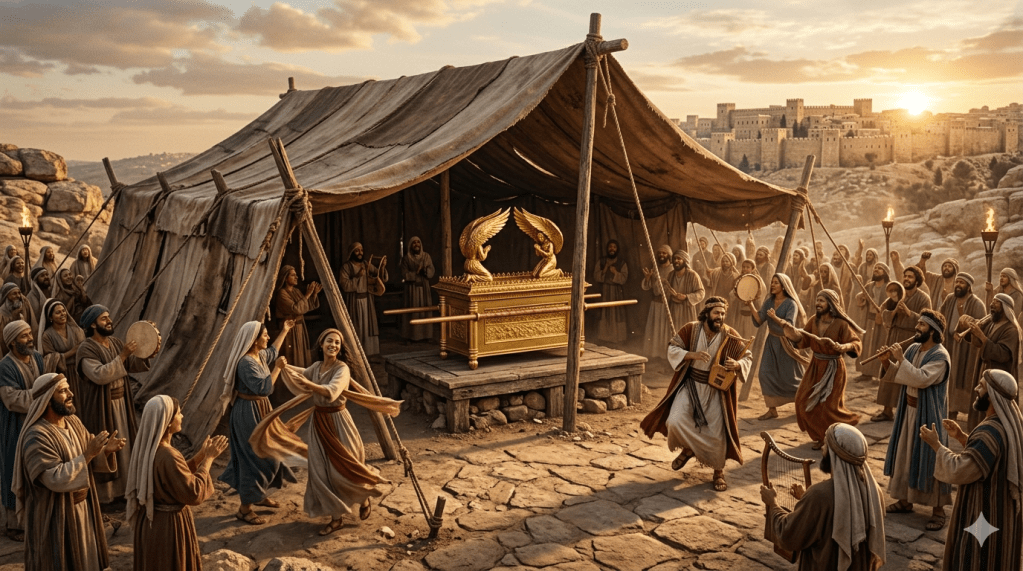
Created using google Gemini nano banana 2 AI image generator.
When the church in Jerusalem was addressing the question whether the Gentiles should be circumcised, and be made to keep the Law of Moses, James quoting Amos said, “After these things I will return and will rebuild the tabernacle of David which has fallen, and its ruins I will rebuild, and I will set it upright, so that the remnant of men may seek out the Lord, and all the Gentiles, upon whom has been called My name, upon them, says the Lord, doing these things.” Acts 15 verses 16 to 17. Here we see the elders of the first church using the fact that the Ark of the Covenant of God was kept in a simple tent, without any of the ceremonies and rules of Moses, to be the confirming Scripture that Gentiles neither needed to be circumcised, nor keep the Law. This simple Tabernacle, without any specification of separation, or a barrier of fence to encompass it, and where the designs and composition of materials are purposely withheld from our knowledge, is meant to be an illustration of unity where all nations are made the dwelling place of God, in a body that is set free from sin. [Joel 2 verses 28 to 32.] As a consequence the elders of the first church established the Tabernacle of David to be an expression of the New Nature as spirit through the Covenant of Grace, where both Jews and Gentiles, Male and Female can all approach God without any distinction. At the same time the Holy Spirit established, how we are to hold this tabernacle in honour of Him who dwells in us, saying, “For it seemed good to the Holy Spirit and to us, to lay upon you no further burden, except these necessary things: “To abstain from things sacrificed to idols, and from blood, and from what is strangled, and from sexual immorality.” Acts 15 verse 29. Therefore, defining the expectation of God in respect to our body, which He Himself will empower us to keep by His Spirit, according to the Covenant of His Grace.
Now, in order for us to understand the merit of the Tabernacle of David to represent the New Creation, we need to know how it came to be. And this begins with Samuel the prophet, whose name means, “God Heard.” In that he is a representation of the salvation of God that came through the Lord Jesus Christ, in which regard Isaiah says, “In an acceptable time I have heard You, And in the day of salvation I have helped You; I will preserve You and give You As a covenant to the people, to restore the earth, to cause them to inherit the desolate heritages.” Isaiah 49 verse 8. And the ministry of Samuel the Prophet was established, when God symbolically removed the Old Covenant, in that, He removed Eli the high priest, and all his descendants from serving before Him, saying, “I will judge his house forever for the iniquity which he knows, because his sons made themselves vile, and he did not restrain them. And therefore I have sworn to the house of Eli that the iniquity of Eli’s house shall not be atoned for by sacrifice or offering forever.” 1 Samuel 3 verses 13 to 14. The result of which was that God raised up Samuel to serve Him in place of Eli, saying, “I will raise up for Myself a faithful priest who shall do according to what is in My heart and in My mind. I will build him a sure house, and he shall walk before My anointed forever.” 1 Samuel 2 verse 35. Now by all accounts, Samuel in the likeness of the Lord had no right to serve as priest, since he is not of the blood descent of the house of Levi. [Hebrews 8 verses 4 to 5.] And the day Samuel’s service as priest was fulfilled, when God gave the Ark of His Covenant to be taken into the hands of the Philistines. On the same day, Eli and his two sons, Hophni and Phinehas died, the day that was best described by the wife of Phinehas as, “Ichabod,” meaning the glory has departed from Israel. [1 Samuel 4 verse 21.] This concept is also best illustrated in the writing of Zechariah chapter 11 verses 1 to 14. Please note, Samuel served as priest in Israel from the day the Ark of the Covenant was outside of the Tabernacle of Moses that was at Shiloh, and did not return all the days of his ministry.
Now, the fact that the Ark of the Covenant of God was taken into the hands of the enemy of Israel, the Philistines, is to portray the Lord descending to the depth of Sheol by the Holy Spirit. [1 Peter 3 verses 18 to 19.] In which respect, Pastor Joseph Prince points out that the name Philistine means, “to wallow in the dust.” From this point forward the Ark of the Covenant does not return back to the Tabernacle of Moses which was at Shiloh, but was kept at Kiriath-Jearim at the house of Abinadab for a long time. Now, Kiriath-Jearim means “Town of the forest,” and Abinadab means, “father of generosity,” this is to illustrate, in Christ Jesus, God is more than willing to Give His Holy Spirit to all who ask Him. [Luke 11 verse 13.] So, the Ark being in Kiritath-Jearim after coming out from the depth of the Philistines is to portray the promise of God that said, “And it shall come to pass afterward that I will pour out My Spirit on all flesh.” Joel 2 verse 28. In that, trees are a representation of nations, as the Lord said referring to Israel and the nations, “Behold the fig tree and all the trees.” Luke 21 verse 29.
It is in this setting that the Prophet Samuel anointed two of the main kings of Israel that came to be, meaning both of them are symbolically partakers of the same salvation in Christ Jesus. The first is Saul, who was physically magnificent to behold. [1 Samuel 10 verses 22 to 23.] And is one who has never endured the test of affliction, his heart firmly set on the pursuit of fleshly matters. He does not consider the kingdom of God, but what is good for himself, seeking to establish his dominance by his own deeds and against the will of God. One who was driven by the fear of man, and seeks to serve God according to such dictates, and not by the word, hence does not honour God. [1 Samuel 13 verses 11 to 14.] And in his disobedience, he continually declined to the point of searching the depth of Sheol through mediums which he once abhorred. The end of which was to fall by the hands of the enemy, and to lose his crown. But this does not change the fact that he was once saved, since the kingdom was his to have and was anointed. As such, he represents all those that fall away, those that are proven false, as ones sown among thorns and thistles, being choked by the things of the world. [Matthew 13 verse 22, Philippians 3 verses 18 to 19.] And as the foolish virgins, he once had the light of the oil upon him, however, his vessel was empty, since throughout his reign the Ark of the Covenant of God was far from him at Kiritath-Jearim. [Matthew 25 verses 1 to 13.]
The second is, David the beloved, and he represents one of a proven faith, as a son who was afflicted, tested, and chastised, his mind being sharpened by the things which He endured. As Paul writes, quoting Proverbs, “My son, do not regard lightly the Lord’s discipline, nor faint being reproved by Him. For the Lord disciplines whom He loves, and He scourges every son whom He receives.” After which he describes the outcome, saying, “And all discipline indeed for those being present, does not seem to be of joy, but of grief; but afterward it yields the peaceable fruit of righteousness to those having been trained by it.” Hebrews 12 verses 5 to 6 & 11. So, David was raised up in the service of God as one who seeks to do all that is in the Heart of God. [Acts 13 verse 22.]
The end of which was that David, as one who is approved, brought the Ark of the Covenant to be the center place in Jerusalem at Mount Zion where he dwelt, that is to say his vessel was full of Oil. So, the Ark of the Covenant of God remained in a simple tent which David had pitched, and there he praised and worshipped God. [2 Samuel 6 verses 12 to 19.] And it is this simple tent that is a representation of the New Covenant believer, as Paul says, “Indeed, being in the tent we groan, being burdened, because we do not wish to be unclothed but to be clothed, so that the mortal may be swallowed up by life. Now the One having prepared us for this very purpose is God, having given to us the pledge of the Spirit.” 2 Corinthians 5 verses 4 to 5. [Ephesians 1 verses 13 to 14.] The main point is that the Tabernacle of David is a representation of our earthly habitation, where the Spirit of God dwells, in that, no distinction between Jew or Gentile is made. It is in this regard that Paul says, “I have been crucified with Christ, and I no longer live, but Christ lives in me.” Galatians 2 verse 20.
So, the Tabernacle of David represents being in the Spirit, our Soul hidden with Christ in God. In that, the root of our soul has changed from that of the blood in Moses, to that of the breath in David. That is when we were in the flesh, the bible states, “For the life of the flesh is in the blood.” Leviticus 17 verse 11. Please note, our life was in the blood, and was closely tied to the dictates of the body as it can be. However, Paul describes our new nature saying, “Set your minds on the things above, not the things on the earth. For you have died, and your life has been hidden with Christ in God.” Colossians 3 verses 2 to 3. Through which he reveals, our life that was in the blood and bound to the flesh, is now set free through death, to be in the spirit on the account of Christ, that is to say in the breath sealed by the Holy Spirit. The key point being, “in God,” which is the same as saying, “[You are] in the Spirit, if indeed the Spirit of God dwells in you.” The consequence of which is that in the Tabernacle of David, our spirit, soul, and body are now brought into unification to be without conflict. As Paul says, “Now may the God of peace Himself sanctify you completely, and may your spirit and soul and body be preserved, entirely blameless at the coming of our Lord Jesus Christ. The One calling you is faithful, who also will do it.” 1 Thessalonians 5 verses 23 to 24. [Romans 8 verse 11.] Meaning one who puts his trust in the Grace of God to do this for him, is kept in the ways of God, by the power of God. Now, this is not apart from our responsibility to draw near to God in faith, our hearts being filled with the word of His Grace, and the sacrifice of our lips, that offer our praise, worship, and thanksgiving, being filled with the fullness of His Holy Spirit, and diligent in prayer. [Ephesians 5 verses 17 to 20, Colossians 3 verses 16 to 17, Jude 1 verses 20 to 21.]
Now, there are a few details that are worth our attention in regard to the Tabernacle of David, in that, when he brought the Ark of the Covenant to the City of David in Jerusalem, only David is listed as making offerings to God, and he gave to the people Bread, Meat, and Raisin Cakes to take home. [2 Samuel 6 verses 12 to 19.] The idea of which is to portray the River of Life that flows from within us for the purpose of those we are sent. [John 7 verses 38 to 39.] The Lord said to Peter, “Feed My lambs,” “Shepherd My sheep,” and “Feed My sheep.” John 21 verses 15 to 17. So, Bread represents food that illustrates the basics of the faith that has to do with the forgiveness of sins, which is given to the young. Meat represents the food that is given to the mature in the revelation of the deep things of God, to guide them in the ways of righteousness. In regard to which Paul said, “For everyone partaking of milk is unskilled in the word of righteousness, for he is an infant. But solid food is for the mature, the ones by constant use having trained the senses for distinguishing both good and evil.” Hebrews 5 verses 13 to 14. Finally we have Raisin Cakes, and these represent the fruits of the vine, meaning Fruits of the Spirit. [Galatians 5 verse 22.] In which respect the Lord said, “I am the vine; you are the branches. The one abiding in Me and I in him, he bears much fruit. For apart from Me you are able to do nothing.” John 15 verse 5.
Last of all, in the Tabernacle of David, there is no mention of the bronze altar, the point of which is to show the believer has passed from the judgment of death in respect to sin. [John 5 verse 24.] Nonetheless, David offered sacrifices on an unspecified altar before the Ark of God, as it says, “So they brought the ark of the LORD, and set it in its place in the midst of the tabernacle that David had erected for it. Then David offered burnt offerings and peace offerings before the LORD.” 2 Samuel 6 verse 17. Please note, in the Law of Moses only the blood is taken before the Ark of the Covenant which is kept behind the veil, while the body is burnt outside. However, we see David making a burnt and peace offering right before the Ark of God, the idea being to illustrate a body that is offered to God as living sacrifice having been set free from sin. As Paul says, “I exhort you, brothers, through the compassions of God, to present your bodies as a living sacrifice, holy to God, well-pleasing, which is your reasonable service.” Romans 12 verse 1. [Romans 6 verse 13.]
So, David represent all those that can be described as, “you may be filled with the knowledge of His will in all spiritual wisdom and understanding to walk worthily of the Lord: pleasing in all, bringing forth fruit in every good work, and growing in the knowledge of God, being strengthened with all power according to His glorious might, unto all endurance and patience with joy, giving thanks to the Father, the One having qualified you for the share of the inheritance of the saints in light.” Colossians 1 verses 9 to 12. And one of the main defining characteristics of David was that he endured all things because he had set the joy of the crown in the promise of God before him. As Paul says of the Lord, “Looking to Jesus, the founder and perfecter of our faith, who in view of the joy lying before Him endured the cross, having despised its shame, and sat down at right hand of the throne of God.” Hebrews 12 verse 2. And it is in the same respect we are also exhorted by Paul to do likewise, in setting our face firmly on the prize of the upward call of God in Christ Jesus, by which we order the conduct of our lives. [1 Corinthians 9 verses 24 to 27, Philippians 3 verses 10 to 14.] And Paul describes the end of this course saying, “I have fought the good fight, I have finished the race, I have kept the faith. From now on the crown of righteousness is laid up for me, which the Lord, the righteous judge, will award to me in that day.” 2 Timothy 4 verses 7 to 8. [Romans 8 verse 17.]
The Division of Soul and Spirit.
Now, it is worth it for us to consider the implication of Saul and David in respect to the Church of God, in that, both of whom were anointed as kings side by side of the same kingdom. Yet, one was described in his decline, while the other in his ascent, through which an illustration is made of one that is approved in the faith, and the other disapproved. As Paul says, “For also it behooves there to be factions among you, so that also the approved should become evident among you.” 1 Corinthians 11 verse 19. [2 Corinthians 13 verse 5.] The theme of the approved being side by side with the disapproved, is evident in all the writers of the New Testament. The significant point for us is that, as Christians, we generally take it for granted that inheriting the kingdom of God is a foregone conclusion, regardless of the manner in which we lived our lives. As a result we give no mind to the warnings given in the parable of the Sower in respect to those that are sown among thorns and thistles, as well as the parable of the Ten Virgins in respect to the foolish virgins without oil. And it is in the same context that Soul and David also stand as an example for us, as ones having the same exact anointing with the same promise of a kingdom before them, yet the manner they conducted their lives proved a different result. Soul, as one who fixed his sight on earthly gain, even at the destruction of others, whom he very well knew served the interests of the kingdom, was disapproved. While David who would not so much raise a hand against one that stood in the election of God, was approved.
And it is in this context that we are able to explain the writing of Paul which states, “For the word of God is living and active, and sharper than any two-edged sword, penetrating even as far as the division of soul and spirit, and of joints and marrows, and able to judge the thoughts and intentions of the heart.” Hebrews 4 verse 12. When considering this statement, we need to bear in mind the term “division of Soul and Spirit,” can only be applied to a believer, whose conscience is cleansed as to remove the barrier that once existed between the two. The governing rule being, in order to be in the spirit we first must have the Spirit of God dwell in us. So, it is in this regard that Paul says, “We should be diligent to enter into that rest, so that no one should fall by the same example of disobedience.” Hebrews 4 verses 11. The point being, Paul is exhorting the believers to be steadfast in faith, holding true to the confession of their mouth to the end, as ones that are taught the deep things of the faith. His focus is to encourage them in respect to the help that is provided on the account of our weakness. [Hebrews 4 verses 14 to 16.] The main point being the New Covenant is all about what is freely given to us by God, which we are expected to appropriate by faith.
So, when considering the question of the division of soul and spirit, we need to ask ourselves, if we were indeed created spirits and we possessed a soul, what need is there for God to separate our spirit from our soul? Why would God draw a distinction between the two? Our spirit would have been just as dead as our soul. God does not make a distinction between the soul that is dead in sin, from that of the body of sin, and both are condemned together, since the desires of the body of sin is not an excuse for the soul that submitted to its whims. [Matthew 10 verse 28.] However, if we are indeed Souls, that are bound to the breath of Life through the Holy Spirit, then the intent of our hearts must be examined. Jeremiah wrote, “I, the LORD, search the heart, I test the mind, Even to give every man according to his ways, according to the fruit of his doings.” Jeremiah 17:10. [Revelation 2 verse 23.] Please note, when saying, search the heart and test the mind, the reference the Lord is making is to the aspects of the Soul of mankind. In this regard Paul also writes, “For the Spirit searches all things, even the depths of God. For who among men knows the things of the man, except the spirit of the man within him?” 1 Corinthians 2 verse 10 to 11. And Proverbs also says, “The spirit of a man is the lamp of the LORD, searching all the inner depths of his heart.” Proverbs 20 verse 27. When we say the spirit of man is the candle of the Lord, the purpose is to illustrate, it is the spirit that is used to discern the thoughts and intents of the heart of mankind. The spirit does not search itself, it must search our mind and heart, that is to say our soul, where the true essence of our being is found.
Having said this, in this instance, it is the Word of God that is living and active and doing the discerning between Soul and Spirit, and this is of great significance, because it is revealing the nature of the one being searched. For context, the Lord said of the unbeliever, “The one rejecting Me and not receiving My words has one judging him: The word which I spoke, that will judge him in the last day.” John 12 verse 48. Meaning, the examination of the thought and intent of the heart of the one that rejected the words of God is pointless, since the Lord said, “The one not believing already has been judged, because he has not believed in the name of the only begotten Son of God.” John 3 verse 18. That is to say, what need is there to examine the heart of the one who is already condemned to death?
However, if referring to a believer that is cleansed from sin through belief of the truth, then, the manner of life they lived according to the Spirit must be open to examination. The basic measuring scale being the goodness of the word of God they have tasted in the knowledge of God. [Hebrews 6 verse 5.] So, the intent of the Soul must be known as being distinct from that of the spirit. And the fact that the Word of God is doing the examination is to illustrate to us it is based on what we know, the revelation of truths we have received, the warnings we either accepted or rejected, all of which will bear consequences. And we have as an example Luke 12 verses 42 to 48, where the servants of the master were judged based on what they knew of the master’s will. In which respect Paul says, “Therefore do not judge anything before the time, until the Lord shall have come, who both will bring to light the hidden things of darkness, and will make manifest the motives of the hearts; and then the praise will come to each from God.” 1 Corinthians 4 verse 5. So, even though our spirit by the Holy Spirit may desire one thing through the knowledge of God, we in the dictates of our own hearts to the whim of our flesh could pursue something contrary, for which we can be held responsible. [2 Timothy 4 verses 3 to 4.] And, in this context we can see why God would seek to separate the Soul from the Spirit, as it relates to the judgment of righteousness, which has to do with the New Creation. And this is the common error that is prevalent among Christians, because we do not make a distinction between the judgment of the first death that came on the account of Adam, with the judgment of the second death that comes on the account of Christ.
Now, the effect of the First Death can be described as the Soul being separated from the Body, as far as it concerns the unbeliever. Likewise, the Second Death can also be expressed in a similar manner, in the division of the soul from the spirit, [and this is the key point,] because it applies to the believer that fell away. As the Lord said of the wicked servant whom the master of the house had made overseer of his house, “He will cut him in two and will appoint him a place with the unbelievers.” Luke 12 verse 46. And Jude also describing this outcome says, “twice having died. [Jude 1 verse 12.] The implication being the separation of the Soul from the Spirit is as it relates to the believer, who once having attained to a form being as a New Creation, yet has fallen away, to die for the second time. We have to bear in mind, the First death is simply described as the spirit departing from the body, as stated in Psalm 146 verse 4, Ecclesiastes 12 verse 7, and James 2 verse 26. However, here, it is the separation of the soul from the spirit, and it is respect to the New Nature.
The fact of the matter is that, we need to be in the state of spirit in order to live as God does, as Peter says, “For to this end the gospel was proclaimed even to the dead, so that they might be judged indeed according to men in the flesh, but they might live in the spirit according to God.” 1 Peter 4 verse 6. Here, we need to note, Peter is describing two distinct forms of being alive, that is a form of existence that is specific to a certain realm. One is according to the flesh which relates to mankind in the natural world, the other is as spirits which is according to God. And it is between these two states that we find the subjects of Peter’s topic, in that, the dead are neither in the flesh, nor are they in the spirit. Meaning, mankind who die in sin are effectively naked souls, as Paul says, “If indeed also having been clothed, we will not be found naked.” 2 Corinthians 5 verse 3. [Revelation 16 verse 15.] That is to say, it is the Soul of Mankind that is held in Sheol or Hades.
So, when Paul says, “Deliver such a one to Satan for destruction of the flesh, so that his spirit may be saved in the day of the Lord.” 1 Corinthians 5 verse 5. What we have to understand is being in the spirit is a status, just as being in the flesh is also a status. In that, Paul considered it to be far better for such a one, that his flesh may be destroyed in the present, so that his status as spirit may remain intact. Please note, the day of the Lord is a reference to the day we come into possession of our inheritance in Christ, the main event of which is that we acquire a spiritual body in the likeness of the heavenly Man, for which the Holy Spirit at present is the guarantee. [Romans 8 verse 23, 2 Corinthians 5 verses 1 to 5, Ephesians 1 verses 13 to 14, Philippians 3 verses 20 to 21.] So Paul is taking this step so that this man may come to his inheritance, and not be cast aside. Please consider, why would Paul make such a statement, if the offender’s status as spirit was not at risk? Why would he subject anyone to torment, in the hands of the worst of all enemies if there was no benefit to be had? Yet, Paul considered it prudent to do this, because he valued the spirit of the man who was at risk of falling away. Meaning, our status as spirit must be preserved in order for us to live as God does!
Paul could not have made that statement in respect to unbelievers. Because this judgment refers to the Day of the Lord, which is entirely different from that of the great white throne of judgement, which comes a thousand years later. [Matthew 25 verses 31 to 46, Revelation 20 verses 11 to 15.] Otherwise, Paul could have simply said, his spirit may be saved on that great day of judgement, but he chose to refer to a day that represents the beginning reign of the Lord Jesus Christ, and this is the significant point! [2 Thessalonians 2 verses 1 to 2.] So, the term spirit is used in respect to believers as it relates to the inheritance of the Kingdom of God, but the saving of the soul as it relates to those who are redeemed from the power of death. [Romans 8 verses 16 to 17.]
The implication is, believers will have to give an account of their lives, and for some it will come with dire consequences. In respect to which Paul said, “For we must all be revealed before the judgment seat of Christ, that each may receive back the things done through the body according to what he did, whether good or evil.” 2 Corinthians 5 verse 10. Likewise, Peter also says, “For it is the time for the judgment to have begun from the house of God; and if from us first, what will be the outcome of those disobeying the gospel of God? And, “If the righteous one is saved with difficulty, where will appear the ungodly and sinner?” 1 Peter 4 verses 17 to 18. Many times we have heard, the judgment seat of Christ is solely for the purpose of giving out reward, and there are no consequences attached. But this is evidently very wrong. Consider, Peter says, “the righteous one is saved with difficulty.” To be considered righteous, we first must believe in the Lord Jesus Christ for the forgiveness of our sins, and must have His Holy Spirit to dwell in us, on the account of whom we are considered righteous. And Peter pointing to these, he says, they are saved with difficulty. [Romans 5 verses 9 to 10.] This is the same implication that is made in respect to those that are sown among thorns and thistles, the pure virgins with empty vessels, and in our analogy of Saul and David. Yet, we think the inheritance of the kingdom of God is a foregone conclusion, to the neglect of the conduct of our lives. [Matthew 25 verses 24 to 31.]
Now, we need to address the only place where the dead in Hades are described as spirits, which is according to Peter’s statement that said, “[Jesus Christ] having been put to death indeed in the flesh, but having been made alive in the spirit, in which also having gone, He preached to the spirits in prison at one time having disobeyed, when the longsuffering of God was waiting in the days of Noah.” 1 Peter 3 verses 18 to 20. Now, the fact that Peter used the term, “the spirits in prison,” to refer to those that were in Hades, can be misinterpreted to mean mankind was indeed created spirits. However, Peter made that statement in the context of those that are saved. Meaning, even though these are referred to as spirits in prison, Paul is taking for granted that they have accepted the offer of life given to them in the preaching of the gospel by the Lord. Hence, the reason he used Noah in respect to the 8 Souls that are saved through the Ark. Please note the distinction he makes, he refers to those that were saved through the Ark as Souls, yet at the same time, he refers to those that are saved from prison as spirits. The idea being, Souls are saved from death, in respect to which, the Lord has said, “If anyone keeps My word, he shall never taste of death, to the age.” John 8 verse 52. However, those who were already in prison are saved as spirits, hence Peter said, “they might live in the spirit according to God.” The fact of the matter is, the option to live as spirits is first revealed in the Lord, as Paul said, “The first man Adam became into a living soul; the last Adam into a life-giving spirit.” 1 Corinthians 15 verse 45. Meaning, the option to be spirit is only made available through the Lord Jesus Christ. So when He was raised, He raised with Him those that were once disobedient, as spirits as He Himself is spirit. [Matthew 27 verse 52 to 53.] So the term, “the spirits in prison,” must be understood in the context of salvation, and is not in any way a statement of affirmation of the original creation of mankind.
Throughout this study we have illustrated the nature of mankind portrayed through two tabernacles in an illustration of a temporary structure, that is our body. The Tabernacle of Moses as an expression of the structure of fallen mankind, where there are distinct divisions of conflict between spirit, soul and body on the account of sin. And the Tabernacle of David as an expression of redeemed mankind also in the body of flesh, however, in a new form of creation where the spirit, soul and body are all brought into unity by the Spirit of God in righteousness. In regards to which the Psalmist says, “Moreover He rejected the tent of Joseph, and did not choose the tribe of Ephraim, but chose the tribe of Judah, Mount Zion which He loved.” Psalms 78 verse 67 to 68. The Tent of Joseph is an expression for the Tabernacle of Moses that was set in Shiloh, located in the mountains of Ephraim, and is an expression of the administration of the Law in respect to the flesh, which God rejected. In favour of the Tabernacle of David set in mount Zion, in an expression of those who walk in the spirit, in the hope of His Mercy and Grace.
The main concept of which was that, being in the flesh and in sin was on the account of the body being under the dominion of the spirit of the world. Likewise, being in the spirit and in righteousness is also on the account of our spirit being under the dominion of the Spirit of God. Through which we have established the true nature of mankind is found in the Soul. And all these have great implications in the understanding of our salvation. For too long, we have held to part of our salvation that has to do with our deliverance from the kingdom of darkness in the forgiveness of sins, which we have wrongfully assumed to be the conclusion of all things. As a result we have neglected our responsibility to walk by the Spirit of God in the knowledge of truth for the inheritance of the kingdom of God. We have to understand mankind was not created spirit, our status in the spirit is entirely on the account of the Lord Jesus Christ who has come to deliver us from being slaves to the flesh. And our new status as spirit requires us to grow in the knowledge and likeness of the Son of God, that we having endured all things with Him may come into our promised eternal inheritance. [Romans 8 verses 16 to 17.]
 Bread Bait.
Leave a comment