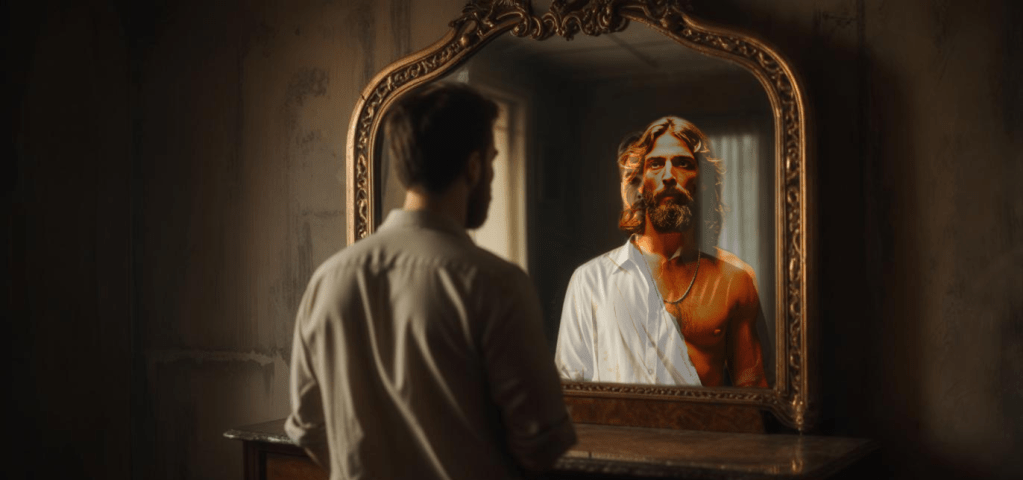
This image was created using https://dream-machine.lumalabs.ai/ with https://pixlr.com/editor/
You can download a PDF of this study: New Creation – PDF
You can also download and listen to an Audio of this study: New Creation – Spotify Podcast
Now, the main text of our study is from, 2 Corinthians 5 verses 16 to 17, which reads, “Therefore from now, we regard no one according to the flesh. Even though we have regarded Christ according to flesh, yet now we regard Him thus no longer. Therefore if anyone is in Christ, he is a New Creation. The Old things have passed away; behold, the New has come into being.”
How we perceive what we were created to be before we obtained salvation through the Lord Jesus Christ, will have bearing on our understanding of what it means to be a New Creation. That is to say, if we believe we were created spirits therefore spiritual we will have a different perspective. And if we believe we were created flesh therefore natural, then another. For the former the fall of Adam, had a complete consequence both spiritual and natural, but for the latter, the fall of Adam had consequence according to the natural only.
When Paul was explaining the fall of Adam, he wrote, “Because of this, just as sin entered into the world through one man, and death through sin, so also death passed to all men, because all sinned.” Romans 5 verse 12. This is the same as saying, “Just as sin entered the natural world through the sin of Adam, we also were made to be sinners because we ourselves were natural.” This might seem like a self-serving point, but Paul could have said, “sin entered into mankind through one man,” and this also would have been true, as he showed in Romans 7 verses 17 to 18, in respect to the body being the dwelling place of sin. The main point is that the object of his discussion in the entire chapter is not nature, but mankind. So, in seeking to explain our condition to us, he clearly chose to make an association between our natural self with that of the world, therefore just as “sin entered the world,” the corresponding consequence of which is that, “sin entered into us.” The key point being, in recognising which part of the make up of mankind is considered natural, it is not our spirit but our body.
So, when addressing the issue of new creation, we first have to come to a clear cut definition of what it means to be natural, and what it means to be spiritual. Paul, writing to the Corinthians first says, “there is a natural body and spiritual body.” Then he follows that with, so it is written, “The first man Adam became a living soul. The Last Adam became a life-giving spirit.” 1 Corinthians 15 verses 44 to 45. The point Paul was trying to make was that the first Adam was natural, therefore flesh, likewise, the Last Adam is spiritual, therefore spirit. Then the fact that we had a spirit within us while we were in the flesh does not necessarily make us spirit. We were natural in a natural body, with a natural mind, living in a natural world for which we were created. We, however, have applied the blanket statement that all of Mankind was created spirits, be it saved or unsaved, and this is the root cause of our error. None of us were created spirits, however, we get to become spirits through faith in the Lord Jesus Christ. The main difference between Adam and Christ, as it concerns the nature of mankind is that, one was flesh therefore natural, while the other is spirit therefore spiritual. And this is the fundamental point which we need to grasp.
For which reason, the term dead in spirit is a fabricated term, that helps us to make sense of the state of natural mankind to whom we have wrongfully attributed spirit-hood. However, the natural mankind is in a fallen state not because of a dead spirit, but because we were born to a fallen world, in a fallen flesh, with the spirit of the world at work in our body, therefore we were of the world. The only way the spirit in a natural man can be described as dead, is as it stands to the authority it had to influence the natural man, which was none. James says, “The Spirit that He has made to dwell in us yearns with envy.” James 4 verse 5. Now, James was not referring to the Holy Spirit, since He was not yet given to dwell in us until the Lord Jesus Christ. And the Lord speaking of this great day to come said, “The one believing in Me, as the Scripture has said: ‘Out of his belly will flow rivers of living water.’ Now He said this concerning the Spirit, whom those having believed in Him were about to receive; for the Spirit was not yet given, because Jesus was not yet glorified.” John 7 verse 39. So, James was referring to the human spirit, that is the breath of life whom we have from God at creation. This spirit was moved to jealousy because we were so given to the dictates of our flesh.
We all can remember a time when our body ruled over us, its desires and cravings, compelled and had mastery over us. But when we came to Christ and received His Holy Spirit, our body of sin was annulled, as such it no longer has authority over us. [Romans 6 verse 6 to 7.] Now, is our body dead? No! We still live in it, but because we have been made spirit through the Holy Spirit, it has lost power over us. Now it is inert! That was exactly the condition of our human spirit before being saved. It also was inert, while sin through our flesh ruled over our soul.
Paul in Romans writes, “The [human body] is dead because of sin,” which is on the account of the fall of Adam. So now by the same measure we have to apply the same principle to the spirit, on the account of the righteous act of Jesus Christ, in regards to which he says, “The [human spirit] is life because of Righteousness.” Romans 8 verse 10. Now, this is not because our human spirit was once dead in sin as our body was. Because if it was, our spirit would also have been subject to death just as our body was. But it is not. Death has no power over our spirit, so our spirit was not dead in sin. God cursed Adam, and we partake of that curse through the natural body. That is why Paul says “in my flesh dwells no good thing,” he did not say in his spirit, but in his flesh. [Romans 7 verses 17 to 18.] Ephesians also describes how we lived to the lust of the flesh and the thoughts of the mind, but it says nothing concerning the dictates of our human spirit. [Ephesians 2 verses 1 to 3.] So, just as in our body death reigned because of Adam’s sin, now life also reigns in our spirit imparted by the Holy Spirit because of Christ’s righteousness.
If sin was in our spirit there would have been no hope for us. But now our failure in the natural is redeemed to a life in the spiritual, and this is the main point of a changed nature. The natural world is doomed to be burned and every natural being with it. Our only salvation is to be made spirits, which Christ the Heavenly Man makes available to us. So just as in Adam we were natural, now in the resurrected Christ we become spiritual. So Paul says, “Though we have regarded Christ according to flesh, yet now we regard Him thus no longer.” If we were truly spirits at creation, then what need did Christ have to become flesh? It would have been our spirit He needed to give an account for, not our flesh. Hebrews says, “For surely He helps not the angels [that is to say spirits], but He helps the seed of Abraham.” And Paul follows that statement with, “Therefore it behoved Him to be made like the brothers in all things.” Hebrews 2 verses 16, & 17. Though it is a derived principle, there is an important point we can take from this. That is Christ did not come to help fallen spirits, but flesh and blood, therefore we were not spirits, be it dead or not.
Here, it is very important for us to realise, falling as spirits means there is no more remedy, for which reason Paul says, “For it is impossible for those once having been enlightened, and having tasted of the heavenly gift, and having become partakers of the Holy Spirit.” Then he says, “And then having fallen away—to restore them again to repentance, crucifying in themselves the Son of God and subjecting Him to open shame.” Hebrews 6 verses 4, & 6. Please note, for them to crucify the Son of God a second time there must first be a change of nature, which is illustrated here in having partaken of the Holy Spirit. Remember, Paul said, “Now you are not in flesh but in Spirit, if indeed the Spirit of God dwells in you.” Romans 8 verse 9. However, because they have continued to walk to the dictates of their flesh to the point of falling away while having become spirits, so now Paul says, they seek to crucify Christ a second time which is not allowed. Christ’s crucifixion was complete as to address all aspects of our fallen state in the flesh. However, the life we live in the spirit is not about sin, but righteousness which is by the Spirit of God. Peter also in a similar manner says, “For if, having escaped the pollutions of the world through the knowledge of the Lord and Savior Jesus Christ, now again having been entangled in these they are subdued, the last state has become worse to them than the first. For it would have been better for them not to have known the way of righteousness, than having known it, to have turned from the holy commandment having been delivered to them.” 2 Peter 2 verse 20. Note the change of nature which is referred to as “the last state,” in contrast to the first.
So when Paul says, “we no longer regard anyone according to the flesh,” he is saying it in terms of “you are not in flesh but in spirit.” And the clause that qualifies us for not being regarded according to the flesh, but as a New Creation is, “if anyone be in Christ.” Which is exactly the same clause that applies to Roman 8 verse 9, that states, “if indeed the Spirit of God dwells in you.” This is the only explicit relationship that is being put forward, life in the flesh or life in the Spirit. The Old nature that passed away, and the New that has come into being. So, if anyone be in Christ, he is in the spirit and no longer in the flesh, as such, he is a New Creation, no longer natural, but now spiritual, no longer a citizen of the world, but now a citizen of Heaven. Then if we can be considered spiritual in the present while we are still in the natural body, then our transition from that of being in the flesh to that of being in the spirit must be as it relates to the position of our Soul, which is the real inner-man. [2 Corinthians 4 verse 16.] For which reason our state in the present is described by terms such as, a promise, a pledge, or a guarantee, which is upheld by the Holy Spirit until the day of the redemption of our body. [Romans 8 verse 23, 2 Corinthians 5 verse 5, Ephesians 1 verses 13 to 14.]
So, as we were born to the natural world bodily, we must also be born to the kingdom of God bodily, but we do that only through death. Christ is called the firstborn from the dead. Christ as our representative in the flesh died in the flesh, and was raised to life in the Spirit. And this is how the Lord made the way for us to follow. Paul shows this, in 2 Corinthians 5, saying if our earthly tent is destroyed, that is to say, our natural body has suffered death, then he says, we have a habitation in heaven, that is a spiritual body. Then it is through death, we put on a spiritual body, and, for those that live in the time of the end, through the rapture, a one time event that is never repeated, to be changed to be spirit as He Himself is spirit. [1 Corinthians 15 verses 51 to 53.] For which reason Peter says, “Christ also suffered once for sins, the righteous for the unrighteous, so that He might bring you to God, having been put to death indeed in the flesh, but having been made alive in the Spirit.” 1 Peter 3 verse 18. So, we are also born to life in the Spirit through death with Him.
The Lord said to Nicodemus, “Truly, truly, I say to you, unless anyone be born of water and of the Spirit, he is not able to enter into the kingdom of God. That having been born of the flesh is flesh, and that having been born of the Spirit is spirit.” John 3 verses 5 to 6. Yet, during Christ’s own ministry while He was in the flesh, not a single soul was born again. The disciples of the Lord were cleansed of sin by His word and faith. Yet Christ did not give them His Spirit, and He could not have because He Himself was in the likeness of Adam, that is of flesh and blood. And the Lord speaking of the Holy Spirit said to them, “But you know [the Holy Spirit], for He abides with you and He will be in you.” John 14 verse 17. He said, “He abides with you,” that is the Spirit did not yet dwell in them. But when Jesus Christ was raised from the dead, having been put to death in the flesh but made alive in the Spirit, Christ the Last Adam became a life-giving spirit. That is Christ is the first Spirit-Mankind, just as Adam was the first flesh-mankind. He now breathed on them and said, “Receive the Holy Spirit.” John 20 verse 22. And when they received that same breath, the Holy Spirit in the form of the Spirit of Christ was now in them and they were now born again. As Paul says, “And He is the head of the body, the church, who is the beginning, firstborn out from the dead, so that He might be holding preeminence in all things.” Colossians 1 verse 18. So the church, of which we are part of, is therefore born from the dead through Him.
So when we receive the Spirit of the resurrected Christ, His accomplishment becomes our own, we also become dead to sinful flesh and alive in the Spirit in righteousness. And this tearing away of sinful flesh is expressed in the burial of our body in water baptism. As Paul describes saying, “The removal of the body of the flesh, in the circumcision of Christ, having been buried with Him in baptism, in which also you were raised with Him through the faith of the working of God, the One having raised Him out from the dead.” Colossians 2 verses 11 to 12. By burying the body in water baptism we are showing sin in the flesh is dead, having been crucified and buried with Christ, in order to be raised up to a new life in the Spirit.
Paul said, “Therefore brothers, having confidence for entering the holy places by the blood of Jesus, by a new and living way, which He dedicated for us through the veil that is His flesh.” Hebrews 10 verses 19 to 20. The work Christ accomplished on the cross, was illustrated in a physical expression in the Temple of God in Jerusalem. Under the Law, between the Mercy seat and the sanctuary, where the priests daily ministered there was a thick veil. This veil was a symbolic representation of the sinful flesh of mankind through which the glory of God was hidden from our sight, through a condemned conscience. So in order to pass through the veil to approach God, the priest had to make an offering for his sins and the sins of the people. [Hebrews 9 verses 1 to 8.] It was because of the presence of sin in our flesh that our perception of God, our desire for Him, and relationship with Him was so obscured. So Paul says, “through the veil that is His flesh.” That is to say, the thousands of sacrifices which Israel had offered throughout the ages did not remove the veil, that is to say a sanctified conscience, but when Christ made His blood an offering for sin once and for all, the veil was torn from top to bottom. [Matthew 27 verse 51.] As a result, through Christ the flesh was no longer a barrier between God and mankind, which is reconciliation. [2 Corinthians 5 verse 18, 1 Peter 3 verse 21.] Now, please note how the spirit was once cut off through the veil from having any influence on the parts of mankind that are represented by Soul and Body. However, in Christ the way is now made open, so the power of God is released to influence both our soul and body according to His own nature. For which reason the Lord says, ““The one believing in Me, as the Scripture has said: ‘Out of his belly will flow rivers of living water.’”
That is Christ tore away the flesh tainted by Adam’s sin, and gave us His Spirit to be united one spirit with Him. So that through Him we now become spiritual as He is Spirit. That is to say, we are cut off from the natural tree which is of the body, and are now grafted to the spiritual tree which is of the spirit, in order to await the redemption of our body so that we may be spirits as He is Spirit. And this is the very heart of Christianity, that is Christ through His Death and Resurrection, made a new way of existing that was not previously available to mankind, which is the New Creation. The term that best describes our journey is that we were once flesh who had a spirit, but now we are spirits who live in a mortal body. As such, where our soul is in subjection will determine our nature, be it to the flesh unto death, or to the Spirit unto life and peace. [Romans 8 verse 6.]
And Paul describing our present state in the world said, “I have been crucified with Christ, and I no longer live, but Christ lives in me. And that which I now live in the flesh, I live through faith from the Son of God, the One having loved me and having given up Himself for me.” Galatians 2 verse 20. That is to say, Christ on the cross not only resembles our sin, but the life we lived in the flesh also. That is the authority of the flesh was removed to make way for the power of God, which is first expressed in Christ, as Paul says, “For that which He died, He died to sin once for all; but that which He lives, He lives to God.” Romans 6 verse 10. And the effect of the outworking of this truth is described by Peter saying, “Who Himself bore our sins in His body on the tree, so that, having been dead to sins, we might live to righteousness.” 1 Peter 2 verse 24. In saying, “we might live for righteousness,” Peter is making the point that the life we live in the flesh while we are in the present world is meant to be by the Spirit of God. For which reason Paul applying these terms to himself says, “I have been crucified with Christ.” He does not say my sin was crucified with Christ but he was. Now we are not our sins, but there is no difference here because it is not only sin Paul sees on the cross, but the life he lived in the flesh, flesh life, natural life is on the cross also. And he summarises these terms when describing the life of a believer and says, “Those who are Christ have crucified the flesh with its passions and desires,” and he immediately follows that with, “If we live by the Spirit, we should also walk by the Spirit.” Galatians 5 verses 24 to 25. That is to say, the life we live in the present is not meant to be dictated by the flesh, but by the Spirit of God who has come to dwell in us, for which reason he says, “Christ lives in me.”
What we need to understand is that, when Jesus Christ came into the world the bible states, “And the Word became flesh and dwelt among us.” John 1 verse 14. And again, “God, having sent His Son in likeness of sin of flesh and for sin, condemned sin in the flesh.” Romans 8 verse 3. And again, “Since the children have partaken of blood and of flesh, He also likewise took part in the same things.” Hebrew 2 verse 14. However, now in contrast to all these statements he says, “the last Adam became a life-giving spirit.” 1 Corinthians 15 verse 45. That is to say, Jesus Christ who came into the world in the form of flesh and blood was now changed to be spirit through death. It is not God who changed, Jesus Christ represents us as flesh mankind, as such His transformation from flesh to spirit must also represent us. There has never been a heavenly mankind, only earthly, but Christ having been made spirit became the first Heavenly Man, and us through Him.
Then our dilemma is solved when we see Adam and Christ as roots for the types of Mankind, which Paul in Corinthians uses terms that help explain the difference. First, in order to express the similarities between the two, he uses terms such as, “The first man Adam, and the last Adam.” However, in the Second pairing, in order to illustrate the distinction between the two he uses terms such as, “the first man, and the Second Man.” In the first segment Christ is described in a term that illustrates a link to Adam’s nature, because He came in the likeness of sinful flesh. However, He is also called “the last,” because Christ’s death not only put away sin, but also the very nature of life in the flesh, for which reason Paul says, “that One has died for all, therefore all have died,” and the consequence of this truth is that, “we regard no one according to the flesh.” 2 Corinthians 5 verses 14, & 16. However, in the second segment, Christ’s relations to the likeness of sinful flesh is completely severed. He is no longer referred to as “the last Adam,” but “the Second Man,” whose origin is definitively described as from heaven, apart from the first man who is from earth. So Paul says, “The first man was made of dust from the earth; the second Man from heaven.” 1 Corinthians 15 verse 47. Please Note, dust signifies the very first moment the first man was created, likewise, Christ entering heaven is to signify the very first moment the Second Man came into being. Mankind was not created for heaven but for the earth. And it took the death and resurrection of the Lord Jesus Christ, for mankind to be made spirit in order to enter heaven.
The Son of God, the Word, was always God in heaven. He had to come down to earth to become Man, and when He was lifted back up to heaven, He stood before the throne of God as the Son of Man. [Acts 7 verse 56, Daniel 7 verse 13.] And Christ as a Spirit-Man was complete in heaven when He put on His spiritual body, for which reason, Jesus Christ is now called the Heavenly Man. So it is also on the account of Him that our origin which was of the earth is also now changed to be of heaven. Heavenly creatures are not described as flesh and blood, but as spirits, just as God is Spirit, the angels are spirits, and Christ the Second Man is also now Spirit. So when Christ comes back He comes back as the Heavenly Man, and we who are in a mortal body will be changed to be like Him. As Paul says, “And as we have borne the image of the earthly, we shall also bear the image of the heavenly.” 1 Corinthians. 15 verse 49.
A New Creation, once flesh but NOW spirits.
 Bread Bait.
Leave a comment